
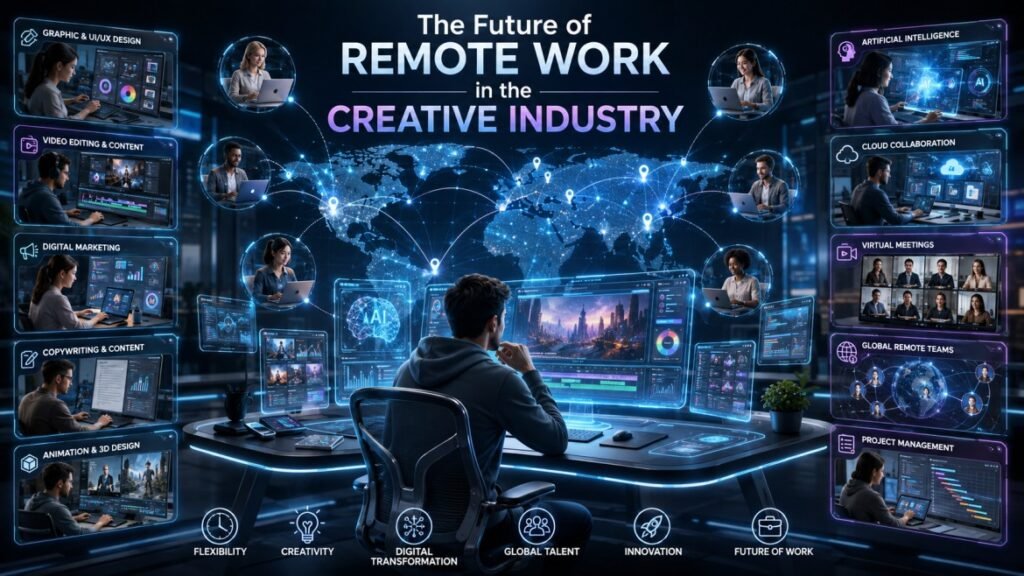
The Future of Remote Work The creative industry has always been driven by ideas, imagination, and collaboration. Today, however, creativity is no longer tied to a particular office, studio, or city. Designers, writers, video editors, developers, marketers, photographers, animators, and other creative professionals can collaborate with clients and teams from almost anywhere.
This shift is being accelerated by cloud platforms, artificial intelligence, real-time collaboration tools, and faster digital connectivity. The Future of Remote Work in the Creative Industry is therefore becoming an important part of the broader future of technology and digital transformation.
Remote work is not simply about working from home. It represents a fundamental change in how creative talent is hired, managed, connected, and measured.
Table of Contents
Why Remote Work Is Growing in the Creative Industry
The Future of Remote Work – Creative work is particularly suitable for distributed teams because many deliverables are digital. A designer can share a prototype online, a copywriter can submit content through a cloud platform, and a video editor can collaborate with a production team without being physically present.
Several factors are driving this transition:
- Cloud-based creative applications
- High-speed internet connectivity
- AI-powered productivity tools
- Video conferencing and virtual meetings
- Digital project-management platforms
- Global freelance marketplaces
- Remote hiring and distributed agencies
- Real-time file sharing and collaboration
For businesses, remote work can provide access to a much larger talent pool. For professionals, it can create opportunities to work with international companies without relocating.
How Technology Is Transforming Remote Creative Work
AI-Powered Creative Workflows
Artificial intelligence is becoming an important creative assistant. AI can help professionals generate ideas, analyze audiences, create drafts, remove repetitive tasks, and accelerate production.
For example, a marketing team could use AI to brainstorm campaign concepts while human creatives refine the messaging, visual identity, and emotional storytelling.
The result is not necessarily the replacement of creative professionals. Instead, the workflow is moving toward human creativity enhanced by intelligent technology.
Cloud-Based Collaboration
Cloud technology allows multiple professionals to work on projects from different locations.
A typical remote creative workflow may include:
- A strategist develops the project brief.
- A designer creates the initial concept.
- A copywriter develops supporting content.
- A video editor produces visual assets.
- The client reviews the work online.
- The team completes revisions through a shared platform.
This workflow reduces geographical limitations and can shorten production cycles.
Virtual Creative Studios
The Future of Remote Work – The next generation of remote agencies may operate almost entirely through virtual environments. Designers, developers, filmmakers, marketers, and consultants could work together through persistent digital workspaces rather than traditional offices.
As virtual collaboration technology improves, creative teams may increasingly use immersive environments for brainstorming, presentations, design reviews, and client meetings.
The Impact of Remote Work on Creative Professionals
The impact of this transformation is significant.
Greater Global Opportunities
A talented designer in India can work with a startup in the United States. A video editor in Europe can collaborate with a media company in Asia. Geographic boundaries are becoming less important when the final product is digital.
More Flexible Careers
Remote work can provide professionals with greater control over their schedules and working environments. This flexibility can also support freelancers, independent creators, parents, and professionals building portfolio careers.
Stronger Competition
Global access to talent also means greater competition. Creative professionals increasingly need more than technical skills.
Important capabilities include:
- Communication
- Creative problem-solving
- Personal branding
- Portfolio development
- Client management
- AI literacy
- Time management
- Cross-cultural collaboration
The Future of Remote work Creative trend
1. AI-Augmented Creative Teams
AI will increasingly become part of everyday creative workflows. Professionals may use AI for research, ideation, editing, personalization, and automation while retaining human control over strategic and creative decisions.
2. Skills-Based Global Hiring
Companies may increasingly evaluate portfolios, practical skills, and project outcomes rather than focusing primarily on location or traditional qualifications.
3. Rise of Distributed Creative Agencies
Small remote agencies can assemble specialized teams from different countries. Instead of maintaining a large permanent workforce, agencies may build flexible teams around specific client projects.
4. Virtual and Immersive Collaboration
Advances in spatial computing, virtual reality, and augmented reality could make remote creative collaboration more interactive.
Imagine a product-design team examining a three-dimensional prototype together even though every member is in a different country.
5. Outcome-Based Performance
Remote creative organizations are likely to focus more heavily on results rather than hours spent online. Quality, deadlines, client satisfaction, innovation, and measurable business outcomes could become more important performance indicators.
Challenges of Remote Work in the Creative Industry
Despite its advantages, remote work creates several challenges.
Communication Gaps
Creative projects often depend on spontaneous conversations. Remote teams need structured communication to prevent misunderstandings and unnecessary revisions.
Collaboration Fatigue
Constant online meetings and notifications can reduce concentration. Organizations need to balance synchronous meetings with asynchronous communication.
Maintaining Creative Culture
A strong creative culture can be harder to maintain when colleagues rarely meet physically. Companies must intentionally create opportunities for collaboration, feedback, recognition, and social interaction.
Cybersecurity and Intellectual Property
Remote teams handle valuable designs, source files, marketing strategies, customer information, and intellectual property. Strong access controls, secure cloud storage, authentication, and cybersecurity policies are becoming essential.
Work-Life Boundaries
Flexibility can become a disadvantage when professionals feel pressured to remain available throughout the day. Clear working hours and communication expectations are necessary for sustainable remote careers.
Opportunities for Businesses and Professionals
The growth of remote creative work creates substantial opportunities.
Businesses can:
- Recruit specialized talent globally.
- Reduce geographical hiring limitations.
- Build flexible project teams.
- Access niche creative expertise.
- Expand into international markets.
Creative professionals can:
- Work with international clients.
- Build global portfolios.
- Develop freelance careers.
- Create digital products.
- Offer specialized consulting services.
- Combine creative skills with AI and automation.
For example, a graphic designer who learns AI-assisted design, UX principles, branding, and digital marketing can potentially offer a broader range of services than a designer relying only on traditional production methods.
How Creative Professionals Can Prepare for the Future
Professionals who want to remain competitive should develop a combination of creative, technical, and business capabilities.
Build an AI-Ready Skill Set
Learn how AI can support research, ideation, content production, editing, automation, and analysis. The goal should be to understand how to integrate AI into professional workflows rather than simply following AI trends.
Create a Strong Digital Portfolio
A portfolio should demonstrate measurable outcomes and problem-solving ability. Instead of showing only finished designs, explain the challenge, creative approach, process, and result.
Improve Remote Collaboration Skills
Being a successful remote creative professional requires excellent written communication, documentation, presentation skills, and time management.
Develop a Personal Brand
LinkedIn, portfolio websites, professional communities, and social platforms can help creative professionals demonstrate expertise and attract opportunities.
What Does the Future Look Like?
The future will probably not be completely remote or completely office-based. A hybrid model is likely to remain important for many creative organizations.
Some activities—such as brainstorming, workshops, client presentations, and production sessions—may benefit from physical interaction. Other activities can be completed efficiently from anywhere.
The strongest organizations will likely create flexible systems that allow teams to choose the right environment for each type of work.
Conclusion
The Future of Remote Work in the Creative Industry is about much more than replacing offices with home workspaces. It represents a broader transformation in how creativity, technology, talent, and business interact.
AI, cloud computing, immersive collaboration, and digital platforms are creating new possibilities for creative professionals and organizations. At the same time, communication, cybersecurity, workplace culture, and skills development will remain critical challenges.
As the future of technology continues to evolve, creative professionals who combine human imagination with digital expertise will be well positioned to benefit from this transformation. The real competitive advantage will not simply be the ability to work remotely—it will be the ability to create, collaborate, innovate, and deliver exceptional results from anywhere.