
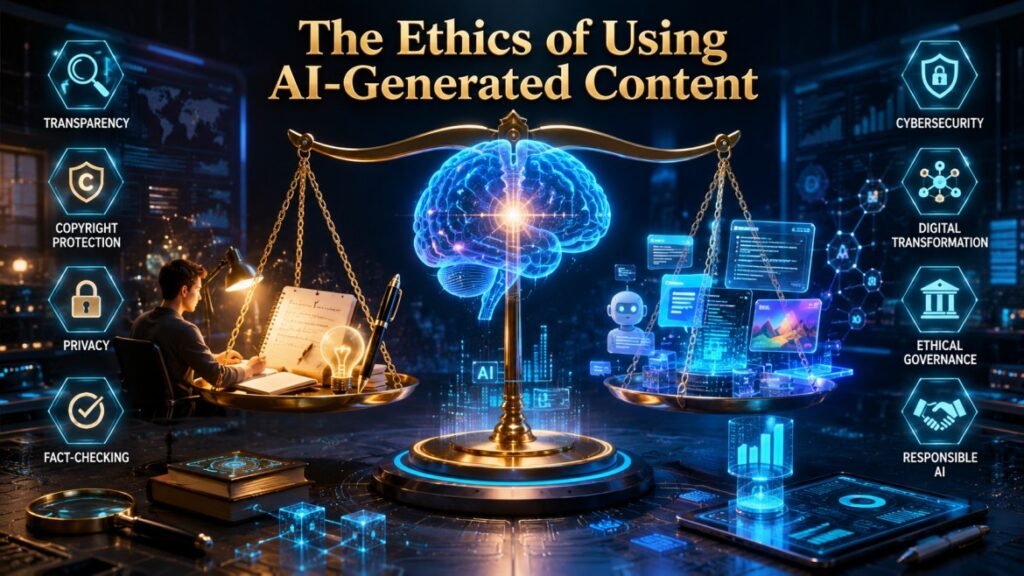
The Ethics of Using AI (Artificial Intelligence) has transformed the way businesses, creators, educators, and marketers produce content. From blog posts and social media captions to product descriptions and marketing campaigns, AI-powered tools are making content creation faster, more scalable, and cost-effective. However, as AI becomes deeply integrated into digital workflows, an important question arises: What are the ethical implications of using AI-generated content?
Understanding The Ethics of Using AI is no longer optional. Organizations must balance technological innovation with transparency, originality, accountability, and human oversight. As the future of technology continues to evolve, ethical AI practices will shape consumer trust, business reputation, and the broader landscape of digital transformation.
This guide explores the ethical challenges, opportunities, and future of AI-generated content while providing practical recommendations for responsible AI adoption.
Table of Contents
What Is AI-Generated Content?
AI-generated content refers to text, images, videos, audio, or code created partially or entirely using artificial intelligence models. These tools analyze vast amounts of data and generate human-like outputs based on user prompts.
Common examples include:
- Blog articles
- Marketing copy
- Social media posts
- Product descriptions
- Email campaigns
- AI-generated images
- Educational materials
- Video scripts
- Customer support responses
While AI dramatically improves productivity, responsible use requires ethical consideration.
Why The Ethics of Using AI Matters
The Ethics of Using AI extends beyond legal compliance. It involves ensuring that AI is used fairly, transparently, and responsibly while respecting creators, consumers, and society.
Ethical AI practices help organizations:
- Build customer trust
- Reduce misinformation
- Protect intellectual property
- Improve transparency
- Maintain content quality
- Strengthen brand credibility
Without ethical standards, AI-generated content can create confusion, spread false information, or unintentionally reinforce harmful biases.
Major Ethical Challenges of AI-Generated Content
1. Originality and Copyright
One of the biggest concerns is whether AI-generated content is genuinely original.
Challenges include:
- Similarity to existing online content
- Copyright infringement risks
- Ownership of AI-created works
- Use of copyrighted training data
Organizations should always review AI-generated material before publication.
2. Transparency
Readers increasingly expect to know whether content was created by humans, AI, or a combination of both.
Best practices include:
- Clearly disclosing AI assistance when appropriate
- Maintaining editorial oversight
- Avoiding deceptive content practices
Transparency builds long-term trust with audiences.
3. Bias and Fairness
AI models learn from existing datasets that may contain historical or societal biases.
Potential issues include:
- Gender bias
- Cultural bias
- Political bias
- Geographic bias
- Stereotyping
Human review remains essential to ensure fairness and inclusivity.
4. Misinformation
AI can occasionally generate inaccurate or fabricated information, often called “hallucinations.”
Before publishing AI-generated content:
- Verify facts
- Cross-check sources
- Review statistics
- Confirm quotations
- Update outdated information
Accuracy should always take priority over speed.
5. Privacy and Data Protection
Organizations must avoid entering confidential or personal information into public AI systems.
Sensitive information includes:
- Customer data
- Financial records
- Medical information
- Internal business documents
- Personal identification details
Responsible AI usage must align with privacy regulations and organizational policies.
Opportunities Created by Ethical AI
When implemented responsibly, AI offers significant advantages.
Improved Productivity
AI reduces repetitive writing tasks, allowing teams to focus on creativity and strategy.
Better Content Personalization
Businesses can deliver tailored experiences for different audiences while maintaining quality standards.
Faster Research
AI accelerates brainstorming, summarization, and content planning.
Global Accessibility
AI helps translate and localize content for international audiences, supporting worldwide communication.
Human + AI: The Ideal Partnership
The most effective content strategies combine AI efficiency with human expertise.
AI Strengths
- Speed
- Automation
- Content generation
- Data analysis
- Idea generation
Human Strengths
- Creativity
- Critical thinking
- Emotional intelligence
- Ethical judgment
- Brand voice
- Contextual understanding
Rather than replacing writers, AI serves as a powerful assistant that enhances human capabilities.
Best Practices for Responsible AI Content Creation
To maintain ethical standards:
- Review every AI-generated article before publishing.
- Fact-check statistics and claims.
- Add original insights and expert opinions.
- Avoid publishing AI-generated misinformation.
- Respect copyright and intellectual property rights.
- Maintain transparency with readers when appropriate.
- Protect confidential business information.
- Continuously update AI governance policies.
These practices improve both quality and credibility.
The Future of Technology and Ethical AI
The future of technology will likely include stronger AI governance, improved transparency tools, and advanced content verification systems.
Expected developments include:
- AI content authenticity standards
- Digital watermarking for AI-generated media
- Automated fact-checking systems
- Responsible AI regulations
- Improved explainable AI models
- Greater collaboration between humans and AI
Businesses that adopt ethical AI frameworks today will be better positioned for long-term success.
The Impact of The Ethics of Using AI-Generated Content on Digital Transformation
The impact of The Ethics of Using AI-Generated Content extends across every industry.
Marketing
More personalized campaigns with greater accountability.
Education
Responsible AI-assisted learning while protecting academic integrity.
Healthcare
Improved patient communication supported by human verification.
Journalism
Faster reporting with stronger editorial oversight.
E-commerce
High-quality product descriptions combined with human quality control.
Ethical AI will become a cornerstone of sustainable digital transformation.
Challenges Organizations Must Overcome
Despite its benefits, organizations still face several challenges:
- Developing AI governance policies
- Managing legal uncertainty
- Detecting AI-generated misinformation
- Maintaining consistent brand voice
- Training employees in responsible AI usage
- Balancing automation with human creativity
Addressing these challenges requires continuous learning and adaptation.
Conclusion
AI-generated content is transforming how the world creates, communicates, and collaborates. However, technology alone cannot guarantee trust. The Ethics of Using AI requires transparency, accountability, fairness, and meaningful human oversight.
Organizations that combine AI innovation with ethical principles will produce higher-quality content, strengthen customer confidence, and remain competitive in an increasingly digital world. As the future of technology continues to accelerate, responsible AI practices will define the next phase of digital transformation and ensure that the impact of The Ethics of Using AI-Generated Content benefits businesses, creators, and society alike.