
Introduction
Imagine someone visits your website, explores a few products or services, reads an article, and then leaves without taking any action. The visitor may have been interested, but something interrupted the decision: the price, lack of time, comparison with another website, or simply distraction.
This is where Retargeting Ads can play an important role.
Retargeting allows businesses to reconnect with people who have previously interacted with their website, app, product page, or digital content. Instead of advertising only to completely new audiences, marketers can create campaigns designed specifically for people who already showed some level of interest.
In today’s competitive digital environment, bringing an existing visitor back can be an important part of a broader customer-acquisition strategy. Combined with analytics, personalization, automation, and digital transformation, retargeting can help businesses create more relevant advertising experiences.
However, successful retargeting is not simply about showing the same advertisement repeatedly. Effective campaigns depend on audience segmentation, timing, creative strategy, frequency management, privacy practices, and continuous optimization.
Table of Contents
What Are Retargeting Ads?
Retargeting Ads are digital advertisements designed to reconnect with people who have previously interacted with a business online but did not complete a desired action.
A visitor might have:
- Viewed a product
- Visited a service page
- Added an item to a cart
- Started a registration process
- Downloaded content
- Read a blog post
- Visited a pricing page
- Watched a video
- Started but did not complete a purchase
Instead of treating these users as completely new prospects, marketers can create audiences based on their previous interactions.
Simple Example
Suppose an online clothing store receives 10,000 website visitors in a month.
Some visitors purchase immediately. Others browse products and leave.
A retargeting campaign could reach eligible previous visitors with relevant advertisements encouraging them to return and continue their purchase journey.
The objective is not simply to increase impressions. The objective is to reconnect with users who have already demonstrated interest.
Why Do Website Visitors Leave Without Converting?
Understanding why people leave is essential before designing a retargeting campaign.
Common reasons include:
1. They Were Only Researching
A visitor may be comparing several products or services before making a decision.
2. The Purchase Decision Requires More Time
High-value products, professional services, insurance, education, and software subscriptions often require multiple interactions.
3. Price Concerns
A visitor may like a product but postpone purchasing because of its price.
4. Distractions
People frequently browse websites while multitasking. They may leave simply because something else demands their attention.
5. Poor User Experience
Slow pages, complicated navigation, unclear calls to action, or lengthy forms can contribute to abandonment.
6. Lack of Trust
Visitors may need additional information about:
- Reviews
- Refund policies
- Security
- Product quality
- Customer support
- Guarantees
Retargeting can help bring visitors back, but it should not be used to hide fundamental problems in the website experience.
How Retargeting Ads Work
The basic process can be understood in five stages:
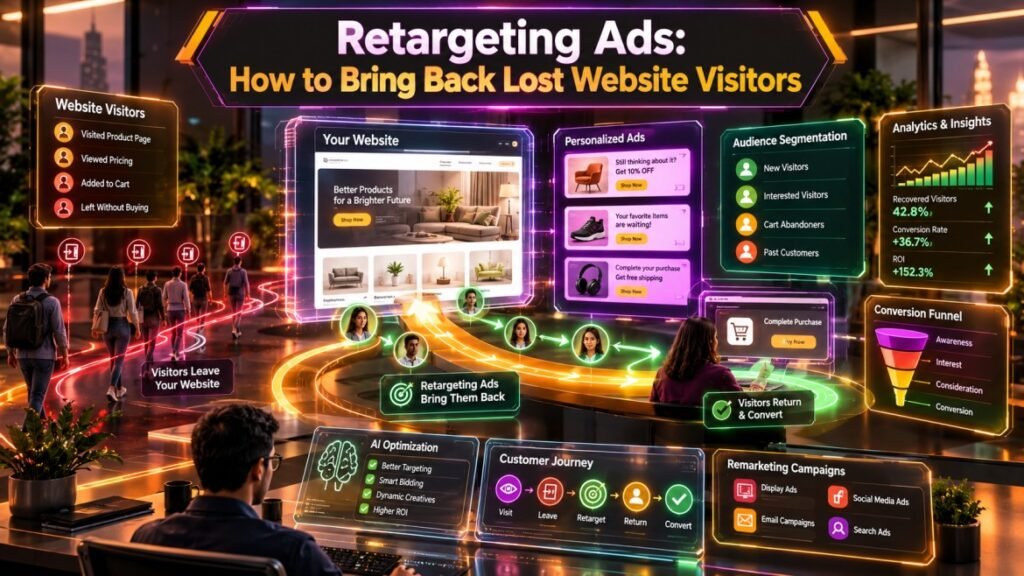
Website Visit → Audience Identification → Segmentation → Advertisement → Return Visit
A visitor interacts with a website or digital property.
Depending on the advertising platform, consent framework, and tracking technology being used, that interaction can contribute to an eligible advertising audience.
The marketer then creates an audience segment and develops an advertisement appropriate to that audience.
When an eligible user encounters an advertising opportunity, the campaign can potentially display a relevant message.
If the visitor returns to the website, the business has another opportunity to provide useful information or encourage conversion.
Types of Retargeting Audiences
Not every visitor should receive the same message.
Audience segmentation is one of the most important components of an effective strategy.
Product Viewers
These users viewed specific products but did not purchase.
Possible message:
“Still exploring this product? Take another look at its features and specifications.”
Cart Abandoners
These visitors added products to their cart but did not complete checkout.
The advertising message can remind them about their unfinished purchase, subject to applicable platform and privacy rules.
Service Page Visitors
A visitor who viewed a consulting or software service page may require more information before contacting the company.
Ads can highlight:
- Benefits
- Case studies
- Demonstrations
- Customer experiences
- Product features
Content Readers
Someone who reads a blog article may not be ready to buy.
Instead of immediately pushing a sales offer, marketers can promote another useful resource, newsletter, webinar, or guide.
Existing Customers
Customer audiences can be used for cross-selling, upselling, retention, or education, where appropriate.
Retargeting vs. Remarketing
The terms retargeting and remarketing are often used interchangeably, but they can describe different approaches depending on the platform and marketing context.
Retargeting is commonly associated with advertising to previous website or digital visitors through advertising networks.
Remarketing can refer more broadly to re-engagement activities, including email-based campaigns and customer communication.
The important point is not the terminology but the strategy: reconnect with an audience that has already demonstrated interest.
How to Create an Effective Retargeting Strategy
Step 1: Define the Objective
Start by identifying the desired action.
Examples include:
- Complete a purchase
- Request a demo
- Submit a lead form
- Register for an event
- Download an ebook
- Return to a service page
- Subscribe to a newsletter
A campaign without a clearly defined objective can become difficult to optimize.
Step 2: Build Relevant Audience Segments
Avoid putting every visitor into one large audience.
Instead, consider segments such as:
- Product viewers
- Cart abandoners
- Pricing-page visitors
- Blog readers
- Returning visitors
- Lead-form abandoners
- Existing customers
Each group can receive a different message.
Step 3: Match the Message to User Intent
A visitor who read an educational blog should not necessarily receive the same advertisement as someone who abandoned a shopping cart.
For example:
Blog reader:
“Explore our complete guide to improving your digital marketing strategy.”
Product viewer:
“Compare the features before making your decision.”
Cart abandoner:
“Your selected items are still waiting in your cart.”
Matching content to intent can improve relevance.
Creative Strategies for Retargeting Ads
Creative quality has a significant influence on advertising performance.
Use Product-Specific Creative
If a visitor viewed a particular product, showing relevant product information can create a more personalized experience.
Highlight Benefits
Instead of listing every feature, explain how the product solves a customer problem.
Use Social Proof
Where accurate and permitted, advertisements can highlight:
- Customer reviews
- Ratings
- Case studies
- Usage statistics
- Testimonials
Create Educational Ads
Not every visitor is ready to buy.
Educational advertisements can help users understand the product before making a decision.
Use Strong Calls to Action
Examples include:
- Explore Now
- View Details
- Start a Free Trial
- Book a Demo
- Learn More
- Complete Your Purchase
Frequency Matters
Showing the same advertisement too many times can create advertising fatigue.
A user may initially find an advertisement relevant but become irritated if it appears repeatedly.
Marketers should monitor:
- Frequency
- Click-through rate
- Conversion rate
- Cost per conversion
- Audience size
- Ad fatigue
- Negative feedback
Frequency controls and audience exclusions can help create a healthier advertising experience.
Landing Pages Matter Too
A common mistake is focusing entirely on the advertisement.
The visitor’s experience after clicking the advertisement is equally important.
The landing page should:
- Match the advertisement
- Load quickly
- Explain the value clearly
- Provide relevant information
- Have an obvious call to action
- Work effectively on mobile devices
- Reduce unnecessary distractions
For example, an advertisement promoting a particular product should ideally take users directly to the relevant product or campaign page rather than a generic homepage.
Measuring Retargeting Campaign Performance
The success of a campaign should be evaluated using meaningful business metrics.
Click-Through Rate
CTR indicates how frequently people click an advertisement after seeing it.
Conversion Rate
Conversion rate measures how many users complete the desired action.
Cost Per Acquisition
CPA helps marketers understand how much they spend to generate a conversion.
Return on Ad Spend
ROAS can help evaluate revenue generated relative to advertising expenditure for campaigns where revenue tracking is appropriate.
View-Through Conversions
Some platforms measure conversions that occur after a user sees an advertisement without clicking it. These measurements should be interpreted carefully because attribution methodologies vary.
Example of a Retargeting Campaign
Consider an online software company.
A visitor arrives on the website and views the pricing page but leaves without requesting a demo.
The company could create a sequence such as:
Stage 1: Reminder
Show an advertisement explaining the software’s primary value proposition.
Stage 2: Education
If the visitor continues without converting, show educational content such as a product guide or feature comparison.
Stage 3: Trust
Present a relevant customer case study or demonstration.
Stage 4: Conversion
Invite the visitor to book a demo or start a trial.
This approach is more sophisticated than displaying the same advertisement repeatedly.
Retargeting and Digital Transformation
The broader digital transformation of marketing is changing how companies understand and communicate with customers.
Organizations now have access to increasingly sophisticated analytics, customer-data platforms, marketing automation, AI-assisted creative tools, and real-time campaign measurement.
The impact of digital transformation is that advertising can become more data-driven and responsive.
Instead of creating one advertisement for an entire audience, businesses can increasingly develop different experiences based on customer behavior and intent.
However, better technology also creates greater responsibility. Organizations need transparent data practices, appropriate consent mechanisms, secure systems, and responsible personalization.
Role of AI in Retargeting
Artificial intelligence is becoming increasingly relevant to digital advertising.
AI can assist marketers with:
- Audience analysis
- Creative variations
- Copy generation
- Campaign optimization
- Predictive analysis
- Customer segmentation
- Product recommendations
- Performance analysis
For example, AI could help identify patterns in campaign data and suggest different creative concepts for different audience segments.
However, marketers should validate AI-generated recommendations rather than automatically implementing them.
Human oversight remains important for brand consistency, privacy, accuracy, and strategic decision-making.
Challenges of Retargeting Ads
Although retargeting can be valuable, it has several challenges.
Privacy and Consent
Modern digital advertising operates within increasingly sophisticated privacy environments.
Businesses need to understand applicable laws, platform policies, consent requirements, and data governance obligations.
Ad Fatigue
Excessive repetition can reduce user engagement.
Attribution Complexity
It can be difficult to determine exactly how much credit an advertisement deserves when a customer interacts with multiple channels before converting.
Audience Size
Smaller websites may not generate enough eligible visitors to create large retargeting audiences.
Poor Segmentation
Treating every visitor identically can result in irrelevant advertisements.
Tracking Changes
Changes in browser technology, privacy controls, platform policies, and measurement systems can affect campaign performance and attribution.
Future Trends in Retargeting
The future of retargeting will likely involve greater emphasis on privacy, first-party data, contextual signals, AI-assisted optimization, and cross-channel customer experiences.
AI-Powered Personalization
AI may increasingly help businesses create different messages for different audience segments.
First-Party Data
Organizations are likely to place greater importance on data collected directly through legitimate customer relationships and consent-based interactions.
Privacy-Centered Advertising
Advertisers will need to balance personalization with user privacy and transparency.
Cross-Channel Experiences
Future campaigns may coordinate experiences across websites, search, social platforms, email, mobile applications, and other digital channels.
Predictive Marketing
Predictive analytics may help marketers identify which audiences require additional education, which are closer to conversion, and which should be excluded from campaigns.
Creative Automation
Generative AI may accelerate the production of multiple advertising concepts, headlines, images, and variations while marketers remain responsible for quality and compliance.
Opportunities for Businesses
Well-planned Retargeting Ads can create opportunities across multiple business models.
E-Commerce
Reconnect with shoppers who viewed products or abandoned carts.
SaaS
Encourage visitors to return for demonstrations, trials, or product information.
Education
Reconnect with students who explored courses but did not complete enrollment.
Travel
Reach users who researched destinations, hotels, or travel packages.
Professional Services
Reconnect with prospects who visited service pages but did not submit an inquiry.
Content Businesses
Promote related content, newsletters, memberships, or educational products to engaged readers.
Best Practices for Retargeting Ads
Use the following checklist when developing a campaign:
- Define a clear conversion objective.
- Segment audiences based on behavior.
- Match advertisements to user intent.
- Create multiple creative variations.
- Use frequency controls where available.
- Exclude users who have already converted when appropriate.
- Test different messages and landing pages.
- Monitor conversion quality, not just clicks.
- Follow privacy and platform requirements.
- Review attribution methodology.
- Refresh advertisements regularly.
- Use analytics to identify weak points in the customer journey.
Common Retargeting Mistakes
Avoid these common problems:
Showing Ads Forever
Set sensible audience membership and campaign durations.
Ignoring Existing Customers
Customers may require different messages from prospects.
Sending Everyone to the Homepage
Use landing pages relevant to the advertisement and visitor intent.
Optimizing Only for Clicks
A high CTR does not necessarily mean a campaign is generating valuable customers.
Using One Creative
Different audience segments may respond to different messages.
Ignoring Privacy
Responsible data management should be part of campaign planning from the beginning.
The Future of Retargeting in a Privacy-First Digital World
The next generation of digital advertising will likely be less dependent on indiscriminate tracking and more focused on meaningful customer relationships.
Businesses will need to develop strategies around:
- Consent
- First-party relationships
- Useful content
- Contextual relevance
- Responsible personalization
- Transparent data practices
- High-quality customer experiences
This shift can change the role of retargeting from simply “following visitors around the internet” to creating useful, permission-aware communication throughout the customer journey.
Final Takeaways
Retargeting Ads provide businesses with a way to reconnect with visitors who have already interacted with their digital properties.
The strongest campaigns do not simply repeat advertisements. They use audience segmentation, relevant creative, appropriate timing, strong landing pages, analytics, and responsible data practices.
The impact of digital transformation is making these strategies increasingly data-driven, while AI is creating new possibilities for personalization and campaign optimization.
At the same time, privacy, attribution, tracking changes, and advertising fatigue remain important challenges.
The future of retargeting will likely depend on finding the right balance between relevance and privacy.
For marketers, the key lesson is simple: bringing a lost visitor back is only valuable when the second interaction provides a better reason to continue the customer journey.