
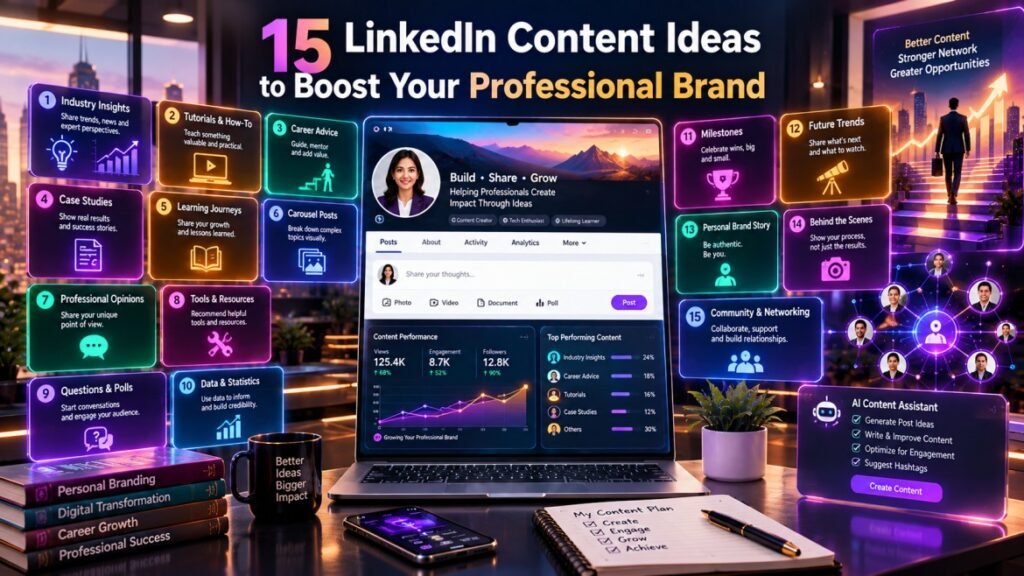
Building a professional brand on LinkedIn is no longer limited to uploading a resume and listing your job experience. Today, professionals, entrepreneurs, consultants, creators, recruiters, and business owners can use LinkedIn to demonstrate expertise, start meaningful conversations, build credibility, and create new career opportunities.
The challenge is knowing what to post on LinkedIn consistently.
A strong content strategy does not require you to publish something groundbreaking every day. The most effective approach is to share useful knowledge, professional experiences, practical lessons, opinions backed by reasoning, and insights that help your audience.
This guide explores 15 LinkedIn Content Ideas that can help you create a recognizable professional presence while adapting to the changing world of work, AI, and digital transformation.
Table of Contents
Why LinkedIn Content Matters for Your Professional Brand
Your LinkedIn profile tells people what you have done. Your content can demonstrate how you think.
Regularly publishing useful content can help you:
- Demonstrate subject-matter expertise
- Increase professional visibility
- Build relationships within your industry
- Start conversations with relevant professionals
- Showcase your communication skills
- Strengthen personal credibility
- Attract potential employers or clients
- Create opportunities for collaboration
However, publishing frequently without a clear purpose can result in repetitive or low-value content.
The objective should be consistent, relevant, and useful communication.
15 LinkedIn Content Ideas to Boost Your Professional Brand
1. Share Industry Insights
One of the easiest ways to demonstrate expertise is to explain what is changing in your industry.
You could discuss:
- New technologies
- Emerging business models
- Industry regulations
- Customer behavior
- Workplace changes
- Market developments
Example
A software testing professional could write:
“AI-assisted testing is changing how QA teams approach test design. Here are three areas where human testers still provide critical value.”
The goal is not merely to report news. Explain why the development matters to professionals in your field.
2. Publish Practical How-To Guides
Educational content is highly useful because readers can immediately apply it.
Create posts explaining how to:
- Use a professional tool
- Solve a common workplace problem
- Prepare for an interview
- Analyze data
- Improve productivity
- Learn a technical skill
- Structure a project
For example:
“How I Structure an API Testing Strategy for a New Application”
Break the process into simple steps and include examples where appropriate.
Practical tutorials are among the most reusable LinkedIn Content Ideas because one topic can often become a post, carousel, video, or longer article.
3. Share a Professional Lesson
Your experience can become valuable content when you turn it into a useful lesson.
Instead of writing:
“I had a difficult project.”
Explain:
- What happened
- What you learned
- What you would do differently
- What other professionals can take from the experience
Example
“What a Production Defect Taught Me About Regression Testing”
This type of post combines personal experience with professional education.
4. Create a Before-and-After Case Study
Case studies make abstract ideas easier to understand.
Show the situation before an improvement and what changed afterward.
A simple structure is:
Before → Action → Result → Lesson
For example:
Before: Manual regression required several days.
Action: The team automated frequently repeated scenarios.
Result: Regression execution became more efficient.
Lesson: Automation should focus on stable, repetitive, high-value scenarios rather than automating everything.
Avoid revealing confidential employer, client, customer, or project information.
5. Explain a Complex Topic Simply
Professionals often appreciate people who can make difficult concepts understandable.
Choose a complicated subject and explain it without unnecessary jargon.
Possible topics include:
- Artificial intelligence
- Cloud computing
- Cybersecurity
- APIs
- Data analytics
- Agile methodology
- Digital marketing
- Software architecture
Example
“API Testing Explained for Beginners: What You Actually Need to Validate”
Use short paragraphs, examples, diagrams, or simple comparisons.
6. Share Career Advice
Career-related content can help you connect with students, job seekers, recruiters, and experienced professionals.
Potential topics include:
- Resume mistakes
- Interview preparation
- Career transitions
- Skill development
- Networking
- Workplace communication
- Professional certifications
- Remote work
Avoid presenting personal experience as a universal rule.
Instead of saying “Everyone must do this,” explain what worked in your situation and why.
7. Post Your Learning Journey
You do not need to be the world’s leading expert before sharing what you are learning.
Document your progress.
For example:
“30 Days of Learning API Automation: What I Learned in Week One”
You can discuss:
- What you studied
- What surprised you
- What was difficult
- What you built
- What you plan to learn next
Learning-in-public content can make your professional brand more authentic while encouraging useful discussions.
8. Create LinkedIn Carousels
Carousels can turn complex information into a visually organized format.
Possible carousel topics include:
“10 Mistakes New QA Engineers Should Avoid”
Slide structure:
- Title
- Problem
- Mistake #1
- Mistake #2
- Mistake #3
- Practical solutions
- Summary
- Call to action
The same topic can be repurposed into a text post, newsletter, video, or blog article.
9. Share Useful Tools and Resources
Professionals constantly look for tools that can help them work more effectively.
Create posts featuring:
- Productivity tools
- AI tools
- Testing tools
- Analytics platforms
- Learning websites
- Browser extensions
- Research resources
Instead of simply listing tools, explain when and why someone should use them.
Example
“7 AI Tools That Can Help QA Engineers With Test Planning and Documentation”
If you have personally used a tool, share your experience and clearly distinguish it from general product claims.
10. Ask Thoughtful Industry Questions
Not every LinkedIn post needs to teach something.
Questions can encourage professional discussion.
For example:
“Will AI reduce repetitive testing work, or will it allow QA engineers to focus more on exploratory testing?”
A good question:
- Has a clear context
- Invites multiple perspectives
- Is relevant to your audience
- Avoids artificial controversy
The quality of the discussion matters more than simply collecting comments.
11. Share Professional Opinions With Evidence
Thought leadership does not mean having a strong opinion about everything.
Choose a relevant subject and explain your position using reasoning, experience, or credible evidence.
For example:
“Why I Think AI Skills Should Become Part of Modern QA Training”
A strong opinion post can follow:
Position → Evidence → Example → Counterpoint → Conclusion
Acknowledging reasonable counterarguments can make the discussion more constructive.
12. Celebrate Professional Milestones
Professional milestones can become opportunities to reflect rather than simply announce an achievement.
You might share:
- Completing a certification
- Starting a new role
- Finishing a project
- Speaking at an event
- Learning a new technology
- Reaching a professional milestone
Instead of only saying:
“I completed my certification.”
Add context:
- Why you pursued it
- What you learned
- What challenged you
- How you intend to apply the knowledge
This makes the post more valuable to your audience.
13. Share Mistakes and Lessons Learned
Failure-related content can be useful when it focuses on learning rather than sensational storytelling.
For example:
“3 Things I Would Do Differently If I Started My QA Career Again”
You could discuss:
- Skills you would learn earlier
- Communication habits you would improve
- Technical concepts you initially underestimated
The key is to turn the experience into actionable advice.
14. Create Data-Driven Posts
Numbers can make professional content more concrete.
You can analyze:
- Industry statistics
- Survey results
- Public datasets
- Product adoption
- Technology trends
- Hiring patterns
- Performance metrics
Always identify the source and date of external data.
A simple format is:
Data → Interpretation → Business/Professional Impact → Takeaway
Data-driven posts can establish credibility when the methodology and context are clear.
15. Publish Your Professional Predictions Carefully
Looking ahead can create engaging conversations about the future of your profession.
Possible topics include:
- The future of AI
- Future workplace skills
- Automation
- Remote collaboration
- Cybersecurity
- Digital transformation
- Emerging technologies
However, distinguish predictions from facts.
Instead of presenting an uncertain prediction as inevitable, explain:
“Here are three developments I am watching and why they could matter.”
This approach makes your content forward-looking without overstating certainty.
How to Build a LinkedIn Content Strategy
Having 15 ideas is useful, but consistency requires a system.
Create four or five content pillars.
Example Content Pillars
Pillar 1: Expertise
- Tutorials
- Industry insights
- Technical explanations
Pillar 2: Career
- Interview advice
- Career lessons
- Skill development
Pillar 3: Experience
- Case studies
- Lessons learned
- Professional milestones
Pillar 4: Emerging Technology
- AI
- Automation
- Digital transformation
- Future trends
Pillar 5: Community
- Questions
- Discussions
- Industry conversations
Rotate between these pillars so your profile does not become repetitive.
A Simple Weekly LinkedIn Content Calendar
You can turn these LinkedIn Content Ideas into a simple publishing schedule.
| Day | Content Type | Example |
|---|---|---|
| Monday | Industry Insight | New technology trend |
| Tuesday | Educational | How-to tutorial |
| Wednesday | Experience | Professional lesson |
| Thursday | Tool/Resource | Useful technology |
| Friday | Discussion | Industry question |
| Weekend | Reflection | Learning journey |
You do not need to publish every day. Choose a frequency you can maintain without sacrificing quality.
How AI Is Changing LinkedIn Content Creation
AI tools can accelerate parts of the content workflow.
They can help with:
- Brainstorming topics
- Creating outlines
- Repurposing content
- Improving readability
- Generating headline variations
- Summarizing research
- Creating content calendars
However, AI should not replace your professional perspective.
A generic AI-generated post can sound similar to thousands of other posts. Your experiences, examples, analysis, and observations are what make professional content distinctive.
A Better AI Workflow
Research → Human insight → AI assistance → Fact-checking → Editing → Publishing → Performance analysis
This approach combines efficiency with authenticity.
Digital Transformation and Your Professional Brand
Digital transformation is changing not only how businesses operate but also how professionals demonstrate their capabilities.
Modern professionals may need to communicate expertise across:
- Personal websites
- Online communities
- Digital portfolios
- Video platforms
- Professional newsletters
The impact of it is that your professional identity increasingly exists across multiple digital touchpoints.
For example, a QA engineer may no longer be represented only by a resume. Their professional presence might include:
- LinkedIn posts about testing
- GitHub projects
- Technical articles
- API testing demonstrations
- Certifications
- Conference participation
- Professional networking
Your digital footprint should therefore accurately represent your real skills and experience.
Future Trends in LinkedIn Content
The future of professional content is likely to become increasingly multimedia and AI-assisted.
AI-Assisted Personalization
AI can help professionals analyze audience interests and adapt content formats.
The important distinction will be between personalized content and mass-produced content.
Video and Visual Learning
Short educational videos, screen demonstrations, presentations, and visual explainers can complement traditional text posts.
Expert-Led Content
As AI-generated content becomes more common, genuine experience and distinctive professional perspectives may become increasingly valuable.
Content Repurposing
One detailed idea can become:
- LinkedIn post
- Carousel
- Short video
- Newsletter
- Blog article
- Presentation
This makes a content system more sustainable.
Professional Communities
LinkedIn content may increasingly become a starting point for deeper professional communities, collaborations, events, and knowledge sharing.
Challenges of Building a Professional Brand on LinkedIn
Building visibility also comes with challenges.
Content Saturation
Thousands of professionals publish similar motivational and career content.
Solution: Add specific examples, original observations, practical frameworks, and genuine experience.
Inconsistent Publishing
Posting heavily for one week and disappearing for a month makes it difficult to establish a sustainable content habit.
Solution: Create a manageable editorial calendar.
Chasing Engagement
Likes and comments can become distracting.
Solution: Track meaningful outcomes such as relevant connections, conversations, profile visits, leads, opportunities, and knowledge-sharing impact.
Maintaining Authenticity
Overusing AI can make posts feel generic.
Solution: Use AI as an assistant while retaining your own voice, experiences, and professional judgment.
Privacy and Confidentiality
Professionals must be careful when discussing workplace experiences.
Never disclose confidential:
- Customer information
- Internal documents
- Proprietary systems
- Credentials
- Unreleased products
- Sensitive business data
Opportunities From LinkedIn Content
A consistent professional content strategy can create opportunities beyond social engagement.
It can support:
- Professional networking
- Recruitment
- Freelance opportunities
- Consulting
- Speaking opportunities
- Industry collaboration
- Personal learning
- Thought leadership
- Business development
The result will vary by industry, audience, content quality, and consistency. Content should therefore be viewed as a long-term professional asset rather than a guaranteed source of opportunities.
10 Social Media Trends That Can Influence LinkedIn Strategy
LinkedIn should not be treated as an isolated platform.
Professionals can observe broader 10 Social Media Trends to understand how digital audiences consume information.
These trends can include:
- Short-form educational video
- Creator-led expertise
- Community-driven conversations
- AI-assisted content creation
- Visual storytelling
- Personal branding
- Social search
- Niche communities
- Content repurposing
- Authentic professional storytelling
The 10 Social Media Trends can provide useful inspiration, but every platform has different audience expectations. A successful strategy on another social network should not simply be copied onto LinkedIn.
The 10 Social Media Trends framework is most useful when you adapt broader social-media behaviors to LinkedIn’s professional context.
Common LinkedIn Content Mistakes to Avoid
Avoid these common problems:
- Posting without a clear audience
- Using excessive hashtags
- Writing extremely long introductions
- Repeating generic motivational quotes
- Copying viral posts
- Making unsupported claims
- Overusing AI-generated language
- Sharing confidential information
- Focusing exclusively on self-promotion
- Chasing likes instead of meaningful engagement
The strongest professional content usually provides a reason for the reader to stop, learn, think, or participate.
Final Thoughts
Building a professional brand on LinkedIn is a long-term process.
You do not need to become a full-time creator. Start with a few reliable content formats that align with your actual expertise.
Use these LinkedIn Content Ideas as a content library. Pick topics that reflect your knowledge, experience, learning journey, and professional interests.
The biggest opportunity is not simply getting more views. It is creating a digital professional identity that accurately communicates what you know, how you think, and what value you can provide.
As AI, automation, and digital transformation reshape professional work, authentic expertise may become even more important.
The future of professional branding will likely involve a combination of human experience, AI-assisted workflows, multimedia storytelling, and meaningful professional communities.
Start with one useful idea. Explain it clearly. Share your experience. Engage with the people who respond. Then improve your approach based on what you learn.
That is how a collection of LinkedIn Content Ideas can evolve into a sustainable professional brand.
Frequently Asked Questions
1. What should I post on LinkedIn?
You can post industry insights, tutorials, career lessons, case studies, learning experiences, professional opinions, useful tools, data analysis, and thoughtful questions.
2. How often should I post on LinkedIn?
There is no universal ideal frequency. Choose a sustainable schedule that allows you to consistently publish useful and high-quality content.
3. Can beginners use LinkedIn for personal branding?
Yes. Beginners can document their learning journey, share useful resources, explain concepts they understand, and participate constructively in industry discussions.
4. Should I use AI to create LinkedIn posts?
AI can assist with brainstorming, outlining, editing, and repurposing. Your personal experience, factual verification, professional judgment, and final editorial control should remain central.
5. What makes LinkedIn content effective?
Relevant topics, useful information, clear writing, authentic experience, strong examples, and meaningful conversations can make professional content more valuable.
6. Can LinkedIn content help with career opportunities?
It can increase professional visibility and create opportunities for networking and conversations, but results vary by industry, audience, content quality, and consistency.
Quick LinkedIn Content Checklist
Before publishing, ask:
- Is this relevant to my professional audience?
- Does the post provide useful information?
- Is the main idea clear?
- Have I included a practical example?
- Are my claims accurate?
- Have I removed confidential information?
- Does the post sound like me?
- Can readers learn something from it?
- Is the formatting easy to scan?
- Does the post encourage meaningful discussion?