
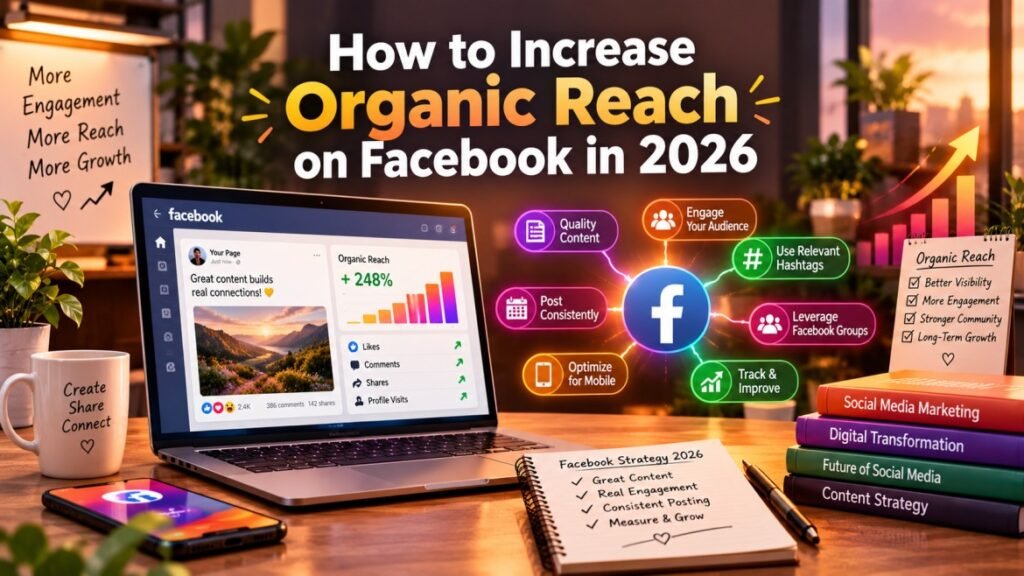
Facebook remains an important platform for businesses, creators, communities, and personal brands in 2026. However, simply publishing posts regularly does not guarantee that people will see them.
The social media environment has changed significantly. Audiences consume short-form videos, participate in communities, search for information directly inside social platforms, and increasingly interact with content created or enhanced using artificial intelligence.
This makes Organic Reach less about posting more frequently and more about creating content that generates meaningful interaction.
The goal is not simply to collect likes. Businesses need to create conversations, encourage shares, provide useful information, understand audience behavior, and build recognizable communities.
At the same time, digital transformation is changing how businesses approach social media. AI-assisted content creation, predictive analytics, automation, personalization, social search, and data-driven decision-making are becoming part of everyday marketing.
So, how can you increase Organic Reach on Facebook in 2026?
The answer lies in combining quality content, audience understanding, community building, video, engagement, experimentation, and intelligent technology.
Table of Contents
What Is Organic Reach on Facebook?
Organic Reach refers to the number of people who see your Facebook content naturally without you paying for advertising.
For example, if you publish a post and Facebook distributes it to followers and other users through feeds, shares, recommendations, groups, or interactions without advertising expenditure, those impressions contribute to your organic distribution.
Organic visibility can come from:
- Facebook Feed
- Reels
- Stories
- Facebook Groups
- Shares
- Comments
- Recommendations
- Search discovery
- Community interactions
- User-generated content
The important point is that organic distribution depends heavily on how people respond to your content.
A post that immediately generates meaningful conversations can potentially receive more visibility than a post that receives little interaction.
Why Organic Reach Matters in 2026
Paid advertising can provide immediate exposure, but businesses should not depend exclusively on advertising.
A strong organic strategy can help businesses:
- Build credibility
- Develop communities
- Increase brand awareness
- Generate repeat engagement
- Strengthen customer relationships
- Reduce dependence on advertising
- Create long-term audience assets
- Understand customer interests
Organic content also provides valuable feedback.
If people repeatedly comment, share, save, or discuss a particular topic, that behavior can reveal what your audience actually considers useful.
This creates a feedback loop:
Content → Engagement → Audience Insights → Better Content → Stronger Community
That cycle is increasingly important in the future of social media marketing.
How Facebook Distribution Works in 2026
Facebook does not treat every post equally.
Content distribution is influenced by multiple signals, including the relationship between users and creators, interactions, content characteristics, and predicted user interest.
Therefore, marketers should stop thinking only about:
“How many followers do I have?”
Instead, ask:
“How valuable is my content to the people who encounter it?”
A smaller but highly engaged community can provide stronger business value than a large audience that rarely interacts.
10 Ways to Increase Organic Reach on Facebook in 2026
1. Create Content Around Your Audience’s Problems
The first step is understanding what your audience actually needs.
Instead of constantly promoting products or services, create content that answers questions and solves problems.
For example, a digital marketing agency could publish:
- Facebook content ideas
- SEO tips
- Common advertising mistakes
- AI productivity techniques
- Social media case studies
- Marketing checklists
- Industry trends
Problem-solving content gives people a reason to stop scrolling.
Example
Instead of:
“Our digital marketing services are available. Contact us today.”
Try:
“5 Facebook Marketing Mistakes That Can Reduce Your Content Visibility.”
The second approach creates curiosity and provides an immediate reason to interact.
2. Prioritize Short-Form Video and Reels
Video continues to be one of the most important content formats for social platforms.
Businesses should experiment with short videos that deliver a clear idea quickly.
Possible formats include:
- Tutorials
- Behind-the-scenes videos
- Product demonstrations
- Quick tips
- Before-and-after examples
- Industry news
- Customer stories
- Frequently asked questions
- Educational explainers
However, simply creating videos is not enough.
The opening seconds should establish why viewers should continue watching.
A simple video structure
Hook → Problem → Insight → Example → Call to Action
For example:
“Your Facebook posts may not be getting enough visibility because you’re making this common mistake…”
Then explain the mistake and provide a practical solution.
3. Encourage Meaningful Conversations
Comments can become a powerful distribution mechanism when they represent genuine conversations.
Instead of asking generic questions such as:
“Do you agree?”
Try specific questions:
- Which strategy has worked for your business?
- What is your biggest Facebook marketing challenge?
- Which AI tool do you use most frequently?
- Would you choose organic marketing or paid advertising for a new brand?
Specific questions are easier to answer and can produce more useful discussions.
The objective should be conversation rather than artificial engagement.
Avoid tactics that encourage meaningless comments solely to manipulate visibility.
4. Build a Facebook Community
Facebook Groups can provide an environment where audiences interact around a shared interest.
For example:
Software Testing Professionals Community
could discuss:
- QA careers
- Automation testing
- AI testing
- API testing
- Interview preparation
- Testing tools
- Industry trends
A community can become more valuable than a simple follower count because members voluntarily return to participate.
Businesses can use communities to:
- Answer questions
- Share educational resources
- Collect feedback
- Understand customer problems
- Identify content opportunities
- Build relationships
Community-driven marketing is likely to remain important in the future.
5. Make Your Content Search-Friendly
Social platforms increasingly function as discovery and search environments.
This means marketers should think beyond traditional Google SEO.
Use relevant phrases naturally in:
- Post descriptions
- Video titles
- Captions
- Image descriptions
- Group discussions
- Educational content
For example, instead of writing:
“Here are some useful tips.”
A more descriptive caption could be:
“7 Facebook marketing strategies for small businesses in 2026.”
The second version clearly communicates the topic.
However, avoid keyword stuffing.
Content should remain natural and useful.
6. Use AI as a Content Assistant
Artificial intelligence is becoming an important part of digital transformation.
AI can help marketers:
- Generate content ideas
- Analyze audience feedback
- Create content outlines
- Repurpose long-form content
- Identify recurring questions
- Develop video scripts
- Generate variations of headlines
- Summarize performance data
But AI should support human creativity rather than completely replace it.
A practical workflow could be:
Audience Research → AI Ideation → Human Review → Content Creation → Publishing → Performance Analysis
The human layer remains important because audiences can recognize generic, repetitive, or disconnected content.
7. Repurpose Your Best Content
You do not need to create something completely new every day.
One strong piece of content can become multiple formats.
For example:
One Blog Article
Can become:
- Facebook post
- Reel
- Carousel
- Infographic
- Question post
- Short video
- Facebook Group discussion
- Story
- Checklist
This approach makes content production more efficient.
It also allows businesses to communicate the same valuable idea in different formats.
8. Publish Consistently, Not Excessively
Consistency matters, but publishing large volumes of low-value content is not a sustainable strategy.
Instead of asking:
“How many posts should I publish?”
Ask:
“How much useful content can I consistently produce?”
A practical weekly structure could include:
| Day | Content Type |
|---|---|
| Monday | Educational post |
| Tuesday | Short video |
| Wednesday | Community discussion |
| Thursday | Industry insight |
| Friday | Reel |
| Saturday | Customer story |
| Sunday | Interactive question |
The exact schedule should be adjusted based on audience behavior and performance data.
9. Use Facebook Insights and Analytics
Data should guide your strategy.
Track metrics such as:
- Reach
- Engagement
- Comments
- Shares
- Video views
- Watch time
- Link clicks
- Follower growth
- Content interactions
Do not evaluate every post using the same metric.
For educational content, shares and comments may be more useful indicators than clicks.
For video, watch time and completion behavior can provide additional insight.
The key is identifying patterns, not obsessing over individual posts.
10. Turn Followers Into Participants
One-way communication is becoming less effective.
Instead of saying:
“Here is our latest product.”
Try:
“We tested three approaches. Which one would you choose and why?”
This changes the audience from passive consumers into participants.
Participation can generate:
- Comments
- Discussions
- User-generated content
- Shares
- Community relationships
- Customer insights
That participation can contribute to stronger Organic Reach over time.
Content Types That Can Support Organic Growth
Different content formats serve different purposes.
Educational Content
Useful for establishing expertise.
Examples:
- Tutorials
- How-to guides
- Checklists
- Explanations
- Industry insights
Entertaining Content
Useful for capturing attention.
Examples:
- Short videos
- Memes
- Behind-the-scenes content
- Trends
- Relatable industry situations
Community Content
Useful for generating conversations.
Examples:
- Polls
- Questions
- Discussions
- Customer stories
- User-generated content
Authority Content
Useful for demonstrating expertise.
Examples:
- Research
- Case studies
- Data analysis
- Expert opinions
- Original observations
A balanced content strategy can combine all four.
Common Mistakes That Reduce Facebook Organic Growth
Posting Only Promotional Content
If every post asks people to buy something, audiences may lose interest.
Use a mixture of:
Educate + Entertain + Engage + Promote
Copying Trends Without Context
A trend may receive attention, but it does not automatically make sense for your audience.
Before using a trend, ask:
- Does it relate to my niche?
- Can I add something original?
- Will my audience understand it?
- Does it support my brand?
Using Clickbait
Clickbait can generate curiosity, but misleading users can damage trust.
A strong headline should create curiosity without making false promises.
Ignoring Comments
Publishing content and ignoring the resulting conversation wastes an important opportunity.
Respond to genuine questions and participate in discussions.
Creating Generic AI Content
AI-generated content can save time, but generic content can become repetitive.
Add:
- Personal experience
- Original examples
- Industry knowledge
- Data
- Human perspective
- Unique observations
This makes content more distinctive.
The Impact of Digital Transformation on Facebook Marketing
Digital transformation is changing how businesses manage customer relationships, marketing, analytics, and communication.
Social media marketing is increasingly connected with:
- Artificial intelligence
- Customer data platforms
- Marketing automation
- CRM systems
- Predictive analytics
- Social listening
- Content automation
- Personalization
The impact of this transformation is significant.
A small business can now use technology to perform activities that previously required larger marketing teams.
For example:
Customer Feedback → AI Analysis → Audience Segmentation → Content Ideas → Human Review → Publishing → Analytics
This creates a more data-driven marketing cycle.
However, technology does not eliminate the need for creativity and strategic thinking.
The competitive advantage increasingly comes from combining technology with human understanding.
How AI Could Shape Facebook Marketing in the Future
The future of social media marketing is likely to involve increasingly intelligent workflows.
AI can potentially help marketers identify:
- Emerging topics
- Audience questions
- Content gaps
- Performance patterns
- Content opportunities
- Customer sentiment
- Different audience interests
Generative AI can also make content repurposing faster.
For example:
One 10-minute video
could potentially become:
- 3 short videos
- 5 social posts
- 1 blog outline
- 10 discussion questions
- 1 email newsletter
- Several visual concepts
Human review remains essential to maintain accuracy, originality, brand consistency, and trust.
Future Trends for Facebook Organic Growth
1. Social Search Will Become More Important
People increasingly discover information through social platforms.
Brands should therefore create content that clearly answers specific questions.
2. Community Will Matter More
Audiences are becoming more selective about which accounts and communities deserve their attention.
Strong communities can create recurring engagement.
3. AI-Assisted Personalization Will Grow
AI can help businesses understand different audience segments and create more relevant content experiences.
4. Original Content Will Become More Valuable
As AI-generated material becomes widespread, genuinely useful and distinctive content can become an important differentiator.
5. Video Will Remain Central
Short-form video will continue to be an important format for communicating ideas quickly.
6. Human Trust Will Remain Critical
Technology can increase efficiency, but trust is built through authenticity, consistency, expertise, and meaningful interaction.
Challenges of Increasing Organic Reach in 2026
Businesses should also recognize several challenges.
Increasing Competition
More brands and creators are competing for limited audience attention.
Content Saturation
Audiences encounter huge amounts of content every day.
Changing Platform Behavior
Social media platforms continuously evolve their recommendation and distribution systems.
AI Content Saturation
AI makes content creation easier, which can also increase the amount of repetitive material.
Measuring Real Business Impact
Reach alone does not necessarily translate into leads, customers, or revenue.
Therefore, businesses should connect social metrics with meaningful business outcomes.
Opportunities for Businesses
Despite these challenges, the future presents significant opportunities.
Businesses can use Facebook to:
- Build niche communities
- Establish subject-matter authority
- Educate potential customers
- Generate conversations
- Develop customer loyalty
- Test marketing ideas
- Repurpose content efficiently
- Combine organic and paid strategies
Small businesses can particularly benefit by focusing on a specific audience instead of trying to appeal to everyone.
A Practical Facebook Organic Growth Framework
Use this framework to build a sustainable strategy:
Step 1: Define Your Audience
Understand their problems, interests, questions, and motivations.
Step 2: Select Content Pillars
Choose 3–5 recurring topics related to your expertise.
Step 3: Create Valuable Content
Focus on education, problem-solving, entertainment, and community.
Step 4: Experiment With Formats
Test Reels, posts, Stories, discussions, and other available formats.
Step 5: Encourage Genuine Interaction
Ask meaningful questions and participate in conversations.
Step 6: Analyze Performance
Identify which topics and formats generate useful engagement.
Step 7: Improve Continuously
Keep successful approaches and modify weak ones.
Step 8: Repurpose
Turn high-performing ideas into additional formats.
This creates a continuous improvement cycle rather than a one-time campaign.
Conclusion
Increasing Organic Reach on Facebook in 2026 requires more than posting frequently.
Successful social media strategies increasingly depend on understanding audiences, creating genuinely useful content, encouraging conversations, developing communities, experimenting with video, and using data intelligently.
Digital transformation and AI are changing the way businesses create and analyze content, but technology alone does not guarantee audience attention.
The future belongs to marketers who can combine AI efficiency with human creativity, authentic communication, useful information, and community building.
Instead of chasing every algorithm update, focus on creating content that people genuinely want to consume, discuss, share, and return to.
That approach can create a stronger foundation for sustainable Facebook growth in the years ahead.