
Introduction
Digital media has become an integral part of everyday life. Social media platforms, video-sharing websites, messaging applications, online communities, streaming services, digital news, and mobile applications have transformed how people communicate, learn, work, and entertain themselves.
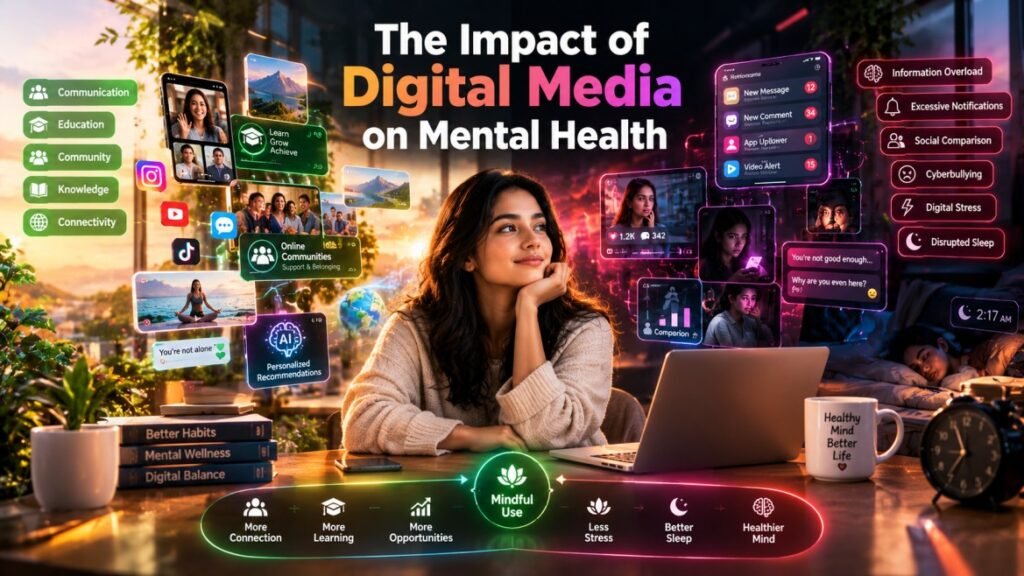
This digital transformation has created unprecedented opportunities for connection and access to information. At the same time, spending significant amounts of time in digital environments can influence emotions, behavior, sleep patterns, social relationships, and overall well-being.
The relationship between technology and Mental Health is complex. Digital media is not inherently positive or negative. Its impact can depend on factors such as the type of content consumed, duration of use, purpose of usage, age, individual circumstances, online experiences, and the ability to maintain healthy boundaries.
Understanding these factors is becoming increasingly important as digital platforms become more personalized and artificial intelligence continues to influence what people see online.
Table of Contents
What Is Digital Media?
Digital media refers to content and communication delivered through digital technologies.
Examples include:
- Social media platforms
- Video and streaming services
- Online news websites
- Messaging applications
- Blogs and podcasts
- Online communities
- Gaming platforms
- Digital learning platforms
- Mobile applications
- Virtual and augmented reality experiences
Unlike traditional media, digital platforms can be interactive and personalized. Users can create content, communicate instantly, receive recommendations, and participate in online communities.
This continuous interaction is one reason digital media can have a significant influence on psychological and emotional well-being.
How Digital Media Can Affect Mental Health
The effects of digital media vary considerably from person to person.
Some people may experience greater social connection and access to helpful information, while others may experience stress, comparison, cyberbullying, information overload, or disrupted sleep.
The important factor is often how digital media is being used, rather than simply whether someone uses it.
Positive Effects of Digital Media
1. Social Connection
Digital platforms allow people to maintain relationships regardless of geographic distance.
Messaging applications, video calls, online communities, and social networks can help people:
- Stay connected with family
- Communicate with friends
- Join communities with shared interests
- Find peer support
- Maintain relationships across countries
For people who have difficulty finding communities locally, online groups can provide an additional avenue for social interaction.
2. Access to Information
The internet has made information more accessible than ever.
People can find educational resources about:
- Stress management
- Sleep
- Emotional well-being
- Healthy lifestyle practices
- Communication
- Personal development
- Professional support
However, information found online should be evaluated carefully. Not every post, video, influencer, or website provides reliable information.
For health-related concerns, trustworthy professional and institutional sources are generally more appropriate than unverified social media content.
3. Online Communities
Digital communities can help individuals connect with people who share similar experiences or interests.
Examples include communities focused on:
- Parenting
- Education
- Chronic conditions
- Career development
- Hobbies
- Fitness
- Personal development
- Support networks
A sense of belonging can be valuable, particularly when people feel isolated from their immediate surroundings.
4. Digital Learning and Self-Improvement
Digital platforms have expanded access to education.
People can use:
- Online courses
- Podcasts
- Educational videos
- E-books
- Meditation applications
- Productivity tools
- Virtual workshops
These resources can support learning and personal development when used appropriately.
Potential Negative Effects of Digital Media
Digital media can also create challenges when usage becomes excessive, compulsive, or emotionally harmful.
1. Social Comparison
Social media frequently presents carefully selected versions of people’s lives.
Users may repeatedly see:
- Luxury lifestyles
- Career achievements
- Travel experiences
- Fitness transformations
- Relationships
- Financial success
Comparing everyday life with highly curated online content can create unrealistic expectations.
A person may begin thinking:
“Everyone else is doing better than me.”
The problem is that social media rarely provides the complete context behind the content.
2. Fear of Missing Out
The constant visibility of other people’s activities can contribute to the feeling that something important is happening without you.
This phenomenon is commonly referred to as FOMO — Fear of Missing Out.
Notifications, trending topics, stories, live streams, and constantly changing feeds can encourage people to check platforms repeatedly.
This can create a cycle:
Notification → Checking → Temporary engagement → New content → More checking
Breaking this cycle can require deliberate digital boundaries.
3. Cyberbullying and Online Harassment
Digital communication can make harmful behavior easier to spread.
Cyberbullying may involve:
- Insults
- Threats
- Public humiliation
- Harassment
- Rumor spreading
- Impersonation
- Coordinated abuse
Unlike traditional bullying, online harassment can potentially reach a person beyond school, college, or workplace environments.
This makes digital safety an important part of responsible technology use.
4. Sleep Disruption
Late-night digital activity can interfere with healthy sleep routines.
Several factors may contribute:
- Prolonged screen use
- Notifications
- Engaging content
- Emotional conversations
- Gaming
- Short-form video consumption
- Staying online instead of going to bed
Poor sleep can affect mood, concentration, productivity, and daily functioning.
Creating a consistent nighttime routine and reducing unnecessary device use before sleep can help establish healthier boundaries.
5. Information Overload
Digital platforms produce enormous quantities of information every day.
Users may encounter:
- Breaking news
- Political discussions
- Advertising
- Short videos
- Messages
- Professional updates
- Entertainment
- Notifications
Constant exposure can become mentally exhausting.
The problem is not necessarily information itself but the continuous demand to process and respond to it.
6. Negative Online Content
Algorithms can repeatedly expose users to content that attracts attention.
Emotionally intense content may generate high engagement, which can encourage continued exposure.
Repeated consumption of negative or distressing material can influence how people perceive their surroundings.
Developing awareness of content consumption patterns can help users make more intentional choices.
Digital Media and Different Age Groups
The effects of digital technology can differ across age groups.
Children and Teenagers
Young people are still developing emotional regulation, social skills, and critical thinking abilities.
Important areas for parents and educators include:
- Screen-time habits
- Online safety
- Cyberbullying
- Privacy
- Social comparison
- Sleep routines
- Exposure to inappropriate content
Rather than focusing exclusively on the number of hours spent online, it can be useful to consider what the child is doing online and how it affects daily life.
Adults
For adults, digital media may combine personal and professional responsibilities.
A smartphone can simultaneously function as:
- A workplace tool
- Communication device
- Entertainment system
- News source
- Shopping platform
- Banking interface
- Social network
This constant connectivity can make it difficult to establish clear boundaries between work and personal life.
Older Adults
Digital technology can provide older adults with opportunities for:
- Family communication
- Online learning
- Entertainment
- Community participation
- Access to information
However, digital literacy and online safety remain important considerations.
The Role of Algorithms
Modern digital platforms do not simply display content chronologically.
Recommendation algorithms can analyze user interactions and personalize feeds.
Signals may include:
- Viewing history
- Search behavior
- Likes
- Comments
- Shares
- Follows
- Time spent viewing content
This personalization can make platforms highly engaging.
From a well-being perspective, users should understand that the content appearing in a feed is not necessarily a neutral representation of reality.
It is often the result of an algorithm optimized around particular engagement objectives.
Digital Media and Emotional Well-Being
The relationship between digital media and emotional well-being can be understood through several interconnected factors.
Healthy digital engagement may involve:
- Meaningful communication
- Educational content
- Creative activities
- Community participation
- Constructive discussions
- Useful professional networking
Potentially unhealthy patterns may involve:
- Compulsive checking
- Continuous comparison
- Online arguments
- Harassment
- Excessive late-night use
- Avoiding offline responsibilities
- Consuming distressing content for long periods
The difference is often determined by purpose, context, frequency, and consequences.
How to Build Healthier Digital Habits
1. Set Specific Boundaries
Instead of attempting to completely eliminate digital media, establish practical boundaries.
For example:
- No unnecessary social media during meals
- Limit notifications
- Establish device-free periods
- Avoid unnecessary checking during work
- Create a consistent bedtime routine
2. Audit Your Digital Feed
Users can periodically review the accounts and communities they follow.
Ask:
- Does this content educate me?
- Does it entertain me positively?
- Does it help me connect with people?
- Does it repeatedly make me anxious or frustrated?
Unfollowing or muting unnecessary content can make a digital environment more intentional.
3. Turn Off Non-Essential Notifications
Not every notification requires immediate attention.
Disabling unnecessary alerts can reduce interruptions and help people regain control over when they interact with their devices.
4. Create Screen-Free Activities
Digital balance does not necessarily mean avoiding technology completely.
It can mean deliberately making space for:
- Walking
- Reading physical books
- Exercise
- Hobbies
- Face-to-face conversations
- Outdoor activities
- Creative projects
Digital Detox: Does It Really Help?
The phrase “digital detox” is often used to describe temporarily reducing digital media use.
A complete technology break may not be practical for people who depend on digital tools for work, education, or communication.
A more sustainable approach may be intentional digital use.
For example:
Instead of:
“I will never use social media again.”
Try:
“I will check social media at specific times and avoid unnecessary scrolling before sleep.”
Small behavioral changes can be easier to maintain over time.
Digital Transformation and Mental Health
The impact of digital transformation extends far beyond social media.
Organizations are adopting:
- Artificial intelligence
- Remote work
- Digital healthcare
- Online education
- Virtual collaboration
- Automation
- Digital financial services
These technologies can improve accessibility and productivity, but they can also create new forms of digital stress.
Examples include:
- Constant workplace connectivity
- Remote-work isolation
- Information overload
- Technology fatigue
- Pressure to respond immediately
- Rapid changes in required skills
Therefore, organizations should consider human well-being alongside technological efficiency.
The Role of Artificial Intelligence
Artificial intelligence is becoming increasingly integrated into digital platforms.
AI can personalize:
- Content recommendations
- Search results
- Advertising
- Educational experiences
- Digital assistants
- Customer interactions
AI-powered applications may also provide tools intended to support well-being, such as journaling, habit tracking, mindfulness exercises, and conversational interfaces.
However, AI should not be treated as a substitute for qualified healthcare professionals.
When someone experiences significant or persistent emotional difficulties, professional support can be important.
Challenges of Digital Media
1. Balancing Engagement and Well-Being
Digital platforms are designed to encourage interaction.
The challenge is finding a balance between useful engagement and excessive consumption.
2. Privacy Concerns
Personal information can be collected through digital services.
Users should understand privacy settings and think carefully about what information they share.
3. Misinformation
Incorrect health information can spread rapidly online.
Users should verify important claims using credible sources.
4. Digital Inequality
Not everyone has equal access to devices, reliable internet, or digital education.
Digital transformation can therefore create benefits for some groups while leaving others behind.
5. Platform Dependency
When communication, work, entertainment, and social interaction all depend on digital platforms, reducing usage can become difficult.
Opportunities Created by Digital Media
Digital media also creates significant opportunities for society.
Education
Online resources can expand access to learning.
Community Building
People can connect across geographic boundaries.
Professional Development
Digital platforms can provide networking, training, and career opportunities.
Accessibility
Technology can make information and communication more accessible to many people.
Public Awareness
Digital campaigns can spread information about well-being and encourage people to seek appropriate support.
The opportunity lies in building digital environments that prioritize useful engagement rather than engagement alone.
Future Trends in Digital Media and Mental Health
1. More Personalized Digital Experiences
AI-driven personalization will continue to influence what users see online.
This may create more relevant experiences but also increases the importance of transparency and user control.
2. Well-Being Features
Digital platforms may increasingly introduce:
- Usage dashboards
- Notification controls
- Break reminders
- Content controls
- Parental tools
- Personalized digital-wellness settings
3. AI-Based Well-Being Tools
AI-powered tools may become more sophisticated in areas such as journaling, habit tracking, and general emotional support.
Their limitations, privacy practices, and appropriate use will remain important considerations.
4. Greater Digital Literacy
Future education may place greater emphasis on understanding:
- Algorithms
- Online manipulation
- Misinformation
- Privacy
- Digital boundaries
- AI-generated content
Digital literacy may become as important as traditional media literacy.
5. Human-Centered Digital Transformation
The future of digital transformation will increasingly involve a balance between technological capability and human needs.
Organizations may need to measure not only productivity and engagement but also usability, accessibility, digital fatigue, and user well-being.
How Businesses Can Support Digital Well-Being
Organizations have an important role to play.
Businesses can consider:
- Reasonable communication expectations
- Clear after-hours policies
- Digital wellness education
- Employee assistance resources
- Healthy remote-work practices
- Reduced unnecessary notifications
- Privacy-conscious technology
- Human-centered product design
Technology should support people rather than create unnecessary pressure.
A Practical Digital Well-Being Checklist
Use the following checklist to evaluate your own digital habits:
- Do I know why I am opening a particular application?
- Do I frequently check notifications without a specific reason?
- Do I use digital media immediately before sleeping?
- Do online interactions regularly affect my mood?
- Do I compare my life with highly curated online content?
- Do I have regular offline activities?
- Have I reviewed my privacy settings?
- Do I verify important information before believing or sharing it?
- Can I spend meaningful periods away from unnecessary digital activity?
- Does my digital usage interfere with work, relationships, sleep, or everyday responsibilities?
The goal is not perfect digital behavior. The goal is greater awareness and intentionality.
Conclusion
Digital media has transformed modern life, creating new opportunities for communication, education, entertainment, professional development, and community building.
At the same time, excessive or unhealthy digital habits can contribute to challenges involving comparison, online harassment, information overload, sleep disruption, privacy, and digital stress.
The impact on Mental Health cannot be reduced to a simple statement that technology is either good or bad. The outcome depends on how technology is designed, how platforms are used, what content people consume, and whether users can maintain healthy boundaries.
As digital transformation accelerates, the future will require a more human-centered approach to technology.
Individuals can develop intentional digital habits. Parents and educators can promote digital literacy. Businesses can design healthier digital experiences. Technology companies can provide greater transparency and user control.
Ultimately, the future of digital media should not be measured only by how much time people spend online or how strongly platforms engage users. It should also be evaluated by whether technology helps people connect, learn, work, and live without unnecessarily compromising their well-being.
Key Takeaways
- Digital media can have both positive and negative effects on emotional and psychological well-being.
- The impact depends on content, context, frequency, purpose, and individual circumstances.
- Social connection and access to information are important potential benefits.
- Social comparison, cyberbullying, information overload, and sleep disruption are important risks.
- AI and personalization are likely to have an increasing influence on digital experiences.
- Digital literacy will become increasingly important as technology evolves.
- Digital transformation should consider human well-being alongside productivity and innovation.
- Healthy digital habits focus on intentional use rather than necessarily eliminating technology.
- The future of digital media will require greater emphasis on privacy, transparency, user control, and human-centered design.