
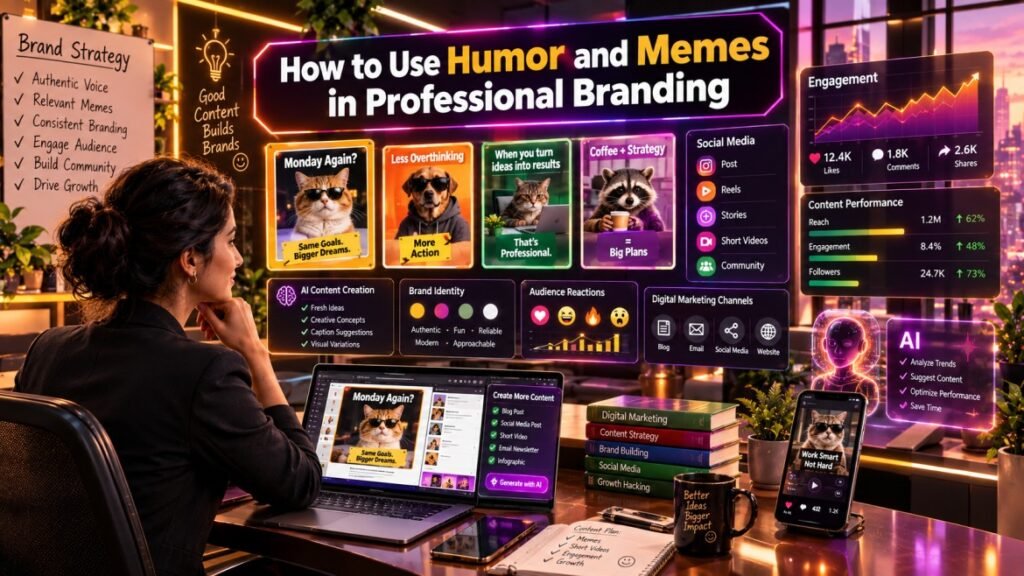
Introduction
Professional branding has traditionally been associated with polished corporate language, formal presentations, carefully designed advertisements, and highly controlled communication.
But digital audiences have changed the rules.
People increasingly interact with brands through social media, short-form videos, online communities, comments, newsletters, and creator-driven content. In these environments, overly formal communication can sometimes feel distant.
This is where Humor and Memes can become valuable branding tools.
A well-timed joke, relatable meme, or clever cultural reference can make a company feel more human and encourage people to stop scrolling. But humor also carries risk. A joke that works perfectly for one audience can appear inappropriate, confusing, or unprofessional to another.
The objective is therefore not to turn every corporate account into a comedy channel.
Instead, businesses can strategically use Humor and Memes to communicate personality, simplify ideas, create memorable content, and develop stronger connections with their target audience.
This guide explores how to use humor professionally, where memes fit into branding, common mistakes to avoid, and what the future may look like as AI and digital transformation continue changing brand communication.
Table of Contents
What Are Humor and Memes in Professional Branding?
Humor is the use of comedy, wit, irony, playful language, or amusing situations to communicate a message.
A meme is a recognizable piece of internet culture—often an image, video, phrase, or format—that people understand and adapt to communicate an idea.
When businesses use these formats intentionally, they become part of a broader content strategy.
For example, a software company might create a meme about:
“When the code works on the first deployment.”
A cybersecurity company could create humorous content around:
“Changing your password from Password123 to Password124.”
The joke attracts attention while reinforcing a professional topic.
The key is that the humor should support the brand rather than replace its identity.
Why Humor Works in Professional Branding
People are exposed to an enormous amount of digital content every day.
Businesses therefore compete not only on product quality but also for attention.
Humor can help a brand stand out because it introduces an emotional element into otherwise informational communication.
1. Humor Makes Brands More Human
Corporate language can sometimes sound robotic.
Compare:
Formal:
“Our platform provides organizations with advanced productivity optimization capabilities.”
Human:
“Less time fighting spreadsheets. More time actually getting work done.”
The second version communicates the same general idea in a more conversational way.
2. Humor Can Improve Memorability
People tend to remember experiences that create an emotional response.
A funny post may be remembered longer than a generic promotional message.
For example, instead of publishing:
“Our customer support team is available 24/7.”
A brand might create a humorous visual around customers contacting support at 2 AM.
The message remains informative while becoming more memorable.
The Psychology Behind Meme-Based Branding
Memes work partly because they use familiar cultural patterns.
A person sees a recognizable format and immediately understands the context.
This reduces the amount of explanation required.
The Basic Meme Formula
Familiar format + Relevant situation + Brand perspective = Shareable content
For example:
Familiar situation: A deadline approaching.
Business context: A marketing campaign launching tomorrow.
Meme: A humorous reaction to the last-minute campaign changes.
The audience understands the situation immediately.
How to Use Humor Without Losing Professionalism
The biggest concern for businesses is often credibility.
Can a serious company use memes without looking immature?
Yes—but context matters.
Match Humor With Your Brand Personality
Not every organization needs the same tone.
A Technology Startup
May use:
- Developer humor
- AI jokes
- Startup culture
- Workplace memes
- Technology references
A Financial Company
May prefer:
- Light educational humor
- Everyday financial situations
- Relatable money jokes
- Industry observations
A Healthcare Brand
May require a more carefully controlled approach, focusing on:
- Everyday experiences
- Educational humor
- Friendly communication
The more sensitive the subject, the more carefully humor should be evaluated.
Types of Humor Brands Can Use
Not all humor needs to be loud or controversial.
Relatable Humor
This is one of the safest approaches.
Example:
“Me: I’ll finish this task in 10 minutes.
Also me, three hours later: researching one completely unrelated problem.”
This type of humor works because audiences recognize the experience.
Observational Humor
Point out something common in your industry.
For example:
A software company could joke about a developer fixing one bug and accidentally creating three more.
Self-Deprecating Humor
A brand can occasionally make fun of itself.
For example:
“We planned to publish this post yesterday. Our content calendar had other plans.”
This can make a company appear more approachable.
However, self-deprecating humor should not undermine confidence in the product or service.
Educational Humor
Use humor to make complicated information easier to understand.
For example, an accounting brand could use a meme to explain why keeping receipts matters.
The audience laughs while learning something useful.
How to Build a Meme Strategy
Successful Humor and Memes content should not be random.
Develop a simple framework.
Step 1: Define Your Audience
Ask:
- Who are they?
- What do they find funny?
- What challenges do they face?
- What cultural references do they understand?
- What tone do they expect from your brand?
A meme designed for software developers will probably not work the same way for senior corporate executives.
Step 2: Define Your Humor Boundaries
Create clear guidelines.
Decide what your brand will:
- Joke about
- Avoid
- Respond to
- Never reference
Avoid humor involving sensitive personal characteristics, tragedies, discrimination, harassment, or topics where a joke could reasonably cause harm.
Step 3: Create Content Pillars
Your meme strategy can revolve around several themes.
For example, a technology brand could use:
Pillar 1: Workplace humor
Pillar 2: Developer jokes
Pillar 3: AI observations
Pillar 4: Customer experiences
Pillar 5: Educational memes
This prevents the content strategy from becoming repetitive.
Humor and Memes Across Different Platforms
The same joke does not necessarily work everywhere.
Professional audiences may respond well to:
- Workplace humor
- Career observations
- Industry jokes
- Leadership humor
- Professional experiences
Keep the context appropriate for the platform.
Visual humor can work particularly well through:
- Memes
- Reels
- Carousels
- Short videos
- Reaction content
X
Fast-moving conversations and topical commentary can provide opportunities for real-time humor, although brands need strong editorial judgment.
TikTok
Humor can be integrated into:
- Short videos
- Trends
- Characters
- Product demonstrations
- Behind-the-scenes content
The key is adapting the creative format rather than simply copying the same post everywhere.
Examples of Professional Meme Marketing
Example 1: SaaS Company
Scenario: Users frequently forget their login details.
Meme concept: A person dramatically searching for a password they created five minutes earlier.
Brand message: Encourage users to use a password manager.
The humor makes the educational message more approachable.
Example 2: Recruitment Brand
Scenario: Candidates say they are “open to opportunities” while applying to 50 jobs.
Meme concept: A humorous representation of checking email every five minutes after submitting an application.
The joke connects directly to the audience’s experience.
Example 3: Digital Marketing Agency
Scenario: A client asks for a campaign to “go viral.”
Meme concept: A humorous reaction showing the difference between a marketing strategy and simply hoping for virality.
The meme can educate clients about realistic marketing expectations.
Using Humor in B2B Branding
B2B companies sometimes assume humor belongs only to consumer brands.
That is not necessarily true.
Business audiences are still people.
A B2B company can use humor around:
- Meetings
- Emails
- Software integrations
- Reporting
- Deadlines
- Procurement
- Presentations
- Workplace culture
The important factor is relevance.
Example
Instead of:
“Our enterprise workflow automation platform improves operational efficiency.”
Try:
“Because copying data between five spreadsheets shouldn’t be someone’s full-time job.”
The second approach introduces personality while communicating a business problem.
Humor and Memes in Content Marketing
Humor does not need to exist independently from educational content.
A strong content strategy can combine:
Educational Content + Entertainment + Brand Personality
For example:
Monday
Educational LinkedIn post
Wednesday
Industry meme
Friday
Short humorous video
Monthly
Long-form expert article
This creates variety while maintaining a consistent brand identity.
Measuring the Impact of Humor
Likes are not the only measurement that matters.
Track metrics such as:
- Engagement rate
- Shares
- Comments
- Saves
- Website traffic
- Brand mentions
- Follower growth
- Newsletter subscriptions
- Leads
- Conversions
Important Question
Don’t ask only:
“Did people laugh?”
Also ask:
“Did the content move the audience closer to the brand?”
A viral meme that generates millions of views but attracts the wrong audience may have limited business value.
The Role of Digital Transformation
Digital transformation has changed the relationship between companies and their audiences.
Brands now operate across:
- Websites
- Social networks
- Messaging platforms
- Communities
- Video platforms
- Newsletters
- AI-powered channels
This fragmented environment creates more opportunities for informal communication.
The impact of digital transformation is therefore not limited to technology infrastructure. It also affects how organizations communicate and build relationships.
Humor can help brands participate in digital conversations in a more natural way.
AI and the Future of Humor-Based Branding
AI is changing content creation rapidly.
Generative AI can help marketers:
- Generate meme concepts
- Brainstorm jokes
- Adapt content for platforms
- Create visual concepts
- Analyze audience reactions
- Produce variations
- Translate humorous content
But there is an important limitation.
Humor depends heavily on:
- Context
- Timing
- Culture
- Human experience
- Shared references
- Emotional intelligence
An AI-generated joke can be grammatically perfect and still be completely unfunny.
Human editorial judgment therefore remains essential.
Future Trends in Humor and Memes
The future of humorous professional branding is likely to become more personalized and multimedia-driven.
1. AI-Assisted Meme Creation
Marketing teams may increasingly use AI to generate multiple creative variations quickly.
Human marketers can then select, edit, and validate the strongest ideas.
2. Personalized Humor
AI may eventually help brands adapt creative content to different audiences.
For example:
Developers → Technical humor
Marketers → Campaign humor
Executives → Business humor
This could increase relevance.
3. Short-Form Video Humor
Memes are increasingly moving beyond static images.
Short videos can combine:
- Dialogue
- Captions
- Reactions
- Music
- Visual effects
- Product demonstrations
4. Community-Driven Content
Brands may increasingly invite audiences to participate in meme creation.
This can turn customers from passive viewers into contributors.
5. Real-Time Cultural Marketing
Brands will increasingly respond to relevant cultural moments, industry events, and online conversations.
However, speed must not eliminate judgment.
Challenges of Using Humor in Professional Branding
Humor can produce excellent engagement, but it also carries risks.
1. Misinterpretation
A joke may be interpreted differently by different audiences.
2. Cultural Differences
A reference that is funny in one country may be confusing or inappropriate elsewhere.
Global brands need additional cultural sensitivity.
3. Trend Expiration
Internet humor changes quickly.
A meme can become outdated within days.
4. Brand Dilution
Using jokes constantly can make it difficult for audiences to understand what the brand actually represents.
5. Reputation Risk
An inappropriate joke can generate negative attention much faster than a conventional marketing post.
This makes review and approval processes important.
A Simple Humor Safety Checklist
Before publishing humorous content, ask:
Is it relevant?
Does the joke relate to your audience or industry?
Is it understandable?
Will your target audience understand the reference?
Is it aligned with the brand?
Does it sound like something your organization would genuinely say?
Could it hurt someone?
Avoid jokes targeting vulnerable groups or sensitive personal characteristics.
Could it damage trust?
If the content became your company’s most widely shared post, would you still be comfortable with it?
Is the timing appropriate?
Avoid making jokes around serious events where humor could appear insensitive.
Opportunities for Businesses
Strategic use of humor can create opportunities in several areas.
Brand Awareness
Memorable content can increase visibility.
Audience Engagement
Humorous posts can encourage comments and sharing.
Community Building
Shared jokes can create a sense of belonging.
Employer Branding
Companies can use workplace humor to show organizational culture.
Product Education
Humor can make complex features easier to understand.
Customer Relationships
A conversational brand voice can make interactions feel less transactional.
How to Create a Professional Meme From Scratch
Use this five-step process.
Step 1: Identify a Common Pain Point
Find something your audience regularly experiences.
Step 2: Find the Emotional Angle
Is it frustrating, surprising, awkward, confusing, or relatable?
Step 3: Add a Recognizable Format
Use a simple visual structure that audiences can understand quickly.
Step 4: Connect It to Your Brand
The joke should have some relationship to your expertise.
Step 5: Add a Useful Takeaway
Where appropriate, connect the humor to:
- A tip
- A product
- An educational resource
- A discussion
- A call to action
This prevents the content from becoming empty entertainment.
Common Mistakes to Avoid
Trying Too Hard to Be Funny
Forced humor is easy to recognize.
Copying Every Viral Meme
Not every trend matches every brand.
Using Offensive Humor
Shock value can create attention but may damage trust.
Ignoring Copyright and Usage Rights
Do not assume that every popular image or video can legally be reused commercially.
Publishing Without Review
A second opinion can identify unintended meanings or cultural problems.
Making Every Post a Joke
A professional brand needs a balanced content mix.
Final Thoughts
Humor and Memes can give professional brands something that traditional corporate communication often lacks: personality.
Used thoughtfully, humor can make complex subjects more approachable, help brands become memorable, encourage engagement, and create a stronger sense of community.
But successful humorous branding is not about trying to make everyone laugh.
It is about understanding your audience, knowing your brand personality, selecting appropriate cultural references, and connecting entertainment with a meaningful business objective.
The future will likely bring even more opportunities as AI, short-form video, personalized content, and digital transformation reshape marketing.
However, technology cannot completely replace human judgment. Context, empathy, timing, and authenticity remain critical.
The strongest strategy is therefore simple:
Be relevant. Be human. Be intentional. And know when not to make a joke.
When these principles are followed, Humor and Memes can become more than viral content—they can become a strategic part of professional branding.