
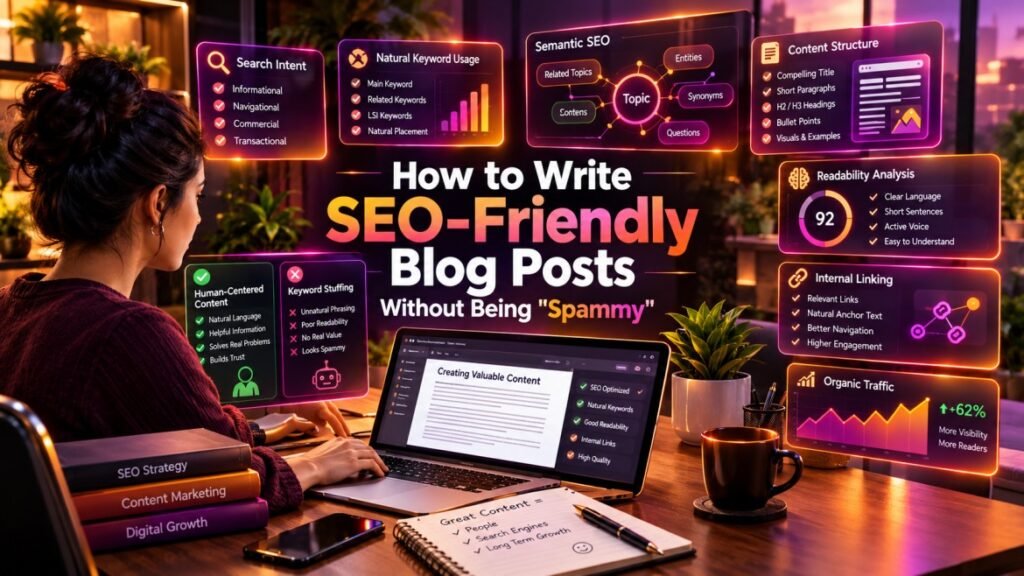
SEO has changed dramatically. In the early days of search engine optimization, publishers could sometimes gain visibility by repeating keywords, creating thin pages, and optimizing content primarily for search engines.
Modern search is different.
Search engines increasingly evaluate whether content is useful, relevant, trustworthy, well-structured, and capable of satisfying the user’s intent. At the same time, AI-powered search and digital transformation are changing how people discover and consume information.
This creates an important challenge for bloggers and businesses: How can you create content that is optimized for search engines without making it feel artificial or “spammy”?
The answer is to put the reader first while using SEO strategically behind the scenes.
An effective SEO-Friendly Blog should answer a real question, provide useful information, use keywords naturally, demonstrate expertise, and offer a smooth reading experience.
SEO should support good content—not replace it.
Table of Contents
What Is an SEO-Friendly Blog?
An SEO-Friendly Blog is a piece of content created to satisfy both user intent and search engine requirements.
It typically combines:
- Useful and original information
- Search-intent alignment
- Natural keyword placement
- Clear headings
- Readable formatting
- Internal linking
- Relevant external references
- Strong page structure
- Mobile-friendly design
- Good technical performance
- Accurate and trustworthy information
The goal is not to insert a keyword into every paragraph.
Instead, the goal is to make the content sufficiently relevant that search engines can understand its subject while readers find it genuinely useful.
What Does “Spammy” Content Look Like?
Spammy content usually prioritizes manipulation over usefulness.
Common warning signs include:
- Excessive keyword repetition
- Unnatural sentences
- Irrelevant keywords
- Duplicate or extremely similar pages
- Very thin content
- Misleading titles
- Excessive promotional language
- Unnecessary internal links
- Generic AI-generated text without meaningful editing
- Content created primarily to attract search traffic rather than help readers
Example of Keyword Stuffing
A poor sentence might look like this:
“Our SEO-Friendly Blog service helps you create an SEO-Friendly Blog because an SEO-Friendly Blog is important for SEO-Friendly Blog rankings.”
The keyword is present, but the writing is unnatural.
Better Approach
“A well-optimized blog should use relevant terminology naturally while focusing primarily on the reader’s search intent.”
The second version communicates an idea instead of forcing a keyword into the sentence.
SEO-Friendly Blog vs. Spammy Blog
| SEO-Friendly Approach | Spammy Approach |
|---|---|
| Natural keyword usage | Repeated keywords |
| Helpful information | Thin information |
| Clear search intent | Traffic-focused content |
| Human-readable writing | Awkward sentences |
| Relevant internal links | Excessive links |
| Original insights | Rewritten generic content |
| Accurate claims | Misleading claims |
| Helpful headings | Keyword-heavy headings |
| Reader-first structure | Search-engine-first structure |
The difference is fundamentally about intent.
If the primary purpose of the article is to help the reader, SEO becomes a supporting mechanism rather than the entire strategy.
How to Write an SEO-Friendly Blog Without Sounding Spammy
1. Start With Search Intent
Before writing, determine what the reader actually wants.
Search intent can generally be divided into several categories.
Informational Intent
The user wants to learn something.
Example:
“How does cloud computing work?”
Navigational Intent
The user wants to find a specific website or resource.
Example:
“Google Search Console login”
Commercial Investigation
The user is comparing options.
Example:
“Best project management tools for small businesses”
Transactional Intent
The user is ready to take an action.
Example:
“Buy accounting software for small business”
Your content should match the intent behind the query.
A detailed educational article is unlikely to satisfy someone who wants a product checkout page.
2. Choose One Primary Topic
Every article should have a clear central theme.
For example:
Primary topic:
How to write SEO-friendly blog posts
Supporting topics could include:
- Keyword research
- Search intent
- Content structure
- Internal linking
- Metadata
- Readability
- Content quality
- SEO mistakes
This creates topical relevance without forcing unrelated keywords into the article.
3. Use Keywords Naturally
Keywords help search engines understand the subject of a page.
However, keywords should fit naturally into the content.
Use them in appropriate locations such as:
- Page title
- H1 heading
- Introduction
- Selected H2/H3 headings
- Body content
- Image ALT text where genuinely descriptive
- Meta description
- URL
- Internal link anchor text when relevant
Avoid inserting the keyword into every heading or paragraph.
Natural Keyword Example
“A strong SEO-Friendly Blog starts with a clear understanding of the audience and the question they are trying to answer.”
The keyword supports the sentence instead of controlling it.
4. Write for Humans First
One of the simplest ways to avoid spammy content is to write naturally.
Imagine that you are explaining the topic to a knowledgeable colleague.
Use:
- Short paragraphs
- Clear sentences
- Concrete examples
- Helpful explanations
- Relevant statistics when available
- Practical recommendations
- Logical transitions
Avoid writing sentences solely because they contain a target keyword.
Good SEO content should be easy to understand even if the reader never thinks about SEO.
5. Create a Strong Introduction
The introduction should quickly explain:
- What the article is about
- Why the topic matters
- What the reader will learn
Avoid beginning with generic statements that could apply to almost any topic.
Weak Introduction
“SEO is very important in today’s digital world. Many people use SEO for their websites.”
Better Introduction
“The biggest SEO mistake is often not using too few keywords—it is using them so aggressively that the article stops sounding human. Modern content needs to balance search visibility with usefulness, clarity, and genuine expertise.”
The second opening establishes a problem and gives the reader a reason to continue.
6. Build a Logical Heading Structure
A well-organized article is easier to read and understand.
A common structure is:
H1: Main article title
H2: Major topic
H3: Supporting topic
For example:
How to Write Better Blog Content
Understand Your Audience
Research Search Intent
Build Content Around Questions
This hierarchy gives readers a clear path through the article.
7. Answer Questions Directly
Question-based content can improve usefulness and readability.
Instead of writing:
“There are many reasons why internal linking is important.”
Try:
Why Is Internal Linking Important?
Internal links help readers discover related information and help search engines understand relationships between pages on a website.
Then provide deeper explanation.
This approach is especially useful for modern conversational and AI-driven search experiences.
8. Avoid Over-Optimization
SEO optimization becomes problematic when every element is aggressively engineered around the same phrase.
Avoid:
- Repeating exact keywords unnecessarily
- Creating awkward keyword variations
- Using the same anchor text everywhere
- Adding irrelevant keywords
- Writing headings only for keyword placement
- Creating multiple pages targeting almost identical queries
Instead, develop a topic comprehensively.
Search engines can understand related concepts and terminology without requiring exact repetition.
9. Use Semantic Keywords
A strong article naturally contains words and concepts related to its primary topic.
For an article about SEO-friendly blogging, related terminology might include:
- Search intent
- Keyword research
- Organic traffic
- Content quality
- Search rankings
- Internal links
- Metadata
- SERP
- User experience
- Topical authority
- Content structure
- Readability
These terms provide context without requiring repetitive exact-match keywords.
10. Create Original Value
Simply rewriting information already available online is unlikely to create a strong long-term content asset.
Add original value through:
- Personal experience
- Practical examples
- Original analysis
- Case studies
- Step-by-step processes
- Expert commentary
- Unique frameworks
- Comparisons
- Real-world scenarios
For example, instead of simply explaining keyword stuffing, show readers a bad example and then rewrite it.
That makes the article more useful.
11. Use Internal Links Strategically
Internal linking can improve navigation and help establish relationships between related articles.
For example, a marketing website might connect:
SEO Blog → Keyword Research Guide → Content Marketing Guide → Technical SEO Guide
Each link should be relevant.
Avoid adding links merely to increase the number of links on a page.
Good Internal Link
Learn more about keyword research strategies in our detailed guide.
Poor Internal Link
Click here for SEO SEO SEO SEO.
The first provides context and value.
12. Write Better Meta Titles and Descriptions
Your title and meta description should accurately represent the page.
A good title should:
- Clearly describe the topic
- Be compelling
- Avoid unnecessary keyword repetition
- Match search intent
A good meta description should summarize the benefit of the page without making unrealistic promises.
Do not write:
“BEST SEO BLOG SEO BLOG SEO BLOG SEO BLOG – #1 SEO BLOG!”
This looks promotional and unnatural.
13. Optimize Images Without Keyword Stuffing
Images can support both accessibility and SEO.
Use descriptive ALT text that explains the actual image.
Poor ALT Text
SEO SEO SEO blog SEO optimization
Better ALT Text
Content writer planning an SEO-friendly blog article on a laptop
ALT text should describe the image rather than act as a keyword container.
14. Improve Readability
Even excellent information can fail if it is difficult to read.
Use:
- Short paragraphs
- Descriptive headings
- Bulleted lists
- Numbered steps
- Tables where appropriate
- Bold emphasis for important concepts
- Examples
- White space
Long blocks of text can discourage readers, particularly on mobile devices.
15. Add Trust Signals
Readers need reasons to trust information.
Depending on the topic, consider including:
- Author credentials
- Publication dates
- Updated dates
- Sources
- References
- Original research
- Examples
- Clear explanations of limitations
For sensitive subjects such as finance, healthcare, legal matters, and security, accuracy and trustworthy sourcing are especially important.
How AI Is Changing SEO Content
Generative AI has dramatically changed content production.
AI tools can help with:
- Topic brainstorming
- Content outlines
- Keyword clustering
- Title ideas
- FAQ generation
- Editing
- Summarization
- Content analysis
However, publishing unedited AI-generated content can create problems.
Generic AI output may contain:
- Repetitive statements
- Weak examples
- Unsupported claims
- Incorrect information
- Generic conclusions
- Similar phrasing
- Lack of firsthand experience
AI should therefore be treated as a productivity tool rather than a replacement for editorial judgment.
A human editor should review important content for accuracy, originality, usefulness, and relevance.
SEO-Friendly Blog Writing Workflow
A practical workflow can look like this:
Step 1: Select a Topic
Choose a topic that has genuine audience value.
Step 2: Research Search Intent
Understand what users expect when searching for the topic.
Step 3: Identify Primary and Related Keywords
Select one main keyword and relevant supporting concepts.
Step 4: Build an Outline
Create H2 and H3 sections around important questions and subtopics.
Step 5: Write the First Draft
Focus on useful information rather than keyword density.
Step 6: Add SEO Elements
Optimize:
- Title
- URL
- Meta description
- Headings
- Internal links
- Images
- ALT text
Step 7: Fact-Check
Verify important claims, statistics, examples, and references.
Step 8: Edit for Humans
Remove repetition and unnatural phrases.
Step 9: Review Search Intent
Ask:
Does this article actually solve the problem that brought the reader here?
Step 10: Publish and Monitor
Track organic performance and update the article when information becomes outdated.
Common SEO Content Mistakes
Keyword Stuffing
Repeating keywords does not automatically create relevance.
Thin Content
Adding thousands of words without useful information does not create quality.
Clickbait Titles
A title should accurately represent what the article delivers.
Duplicate Content
Publishing substantially similar articles can create unnecessary competition between pages.
Irrelevant Links
Links should help readers, not simply exist for SEO purposes.
Excessive AI Content
Automation without editorial oversight can reduce originality and factual reliability.
Ignoring Existing Content
Before creating another article, check whether your website already covers the topic.
Sometimes improving an existing article is more useful than publishing another similar page.
Measuring the Performance of Your Content
SEO success should not be measured only by rankings.
Consider monitoring:
- Organic impressions
- Organic clicks
- Click-through rate
- Engagement
- Conversions
- Returning visitors
- Internal-link clicks
- Search queries
- Content updates
- Leads or sales generated
A page receiving fewer visitors but generating highly relevant leads may be more valuable than a page attracting large amounts of unrelated traffic.
SEO and Digital Transformation
Digital transformation is changing how businesses create, distribute, discover, and evaluate information.
Websites are increasingly connected with:
- AI systems
- Search platforms
- Customer data platforms
- Marketing automation
- Analytics tools
- Recommendation engines
- Conversational interfaces
This increases the importance of structured, accurate, and trustworthy content.
An SEO-Friendly Blog can become more than a traffic-generation asset. It can serve as a knowledge resource that supports customers across multiple digital channels.
For example, a detailed product guide could support:
- Organic search
- Customer support
- AI assistants
- Sales teams
- Email campaigns
- Social media
- Internal knowledge systems
The impact of good content can therefore extend well beyond traditional search rankings.
Future Trends in SEO-Friendly Content
1. Search Will Become More Conversational
Users are increasingly asking complete questions rather than entering short keyword combinations.
Content will need to address questions naturally and comprehensively.
2. AI-Powered Search Will Change Discovery
AI-generated summaries and conversational search interfaces are changing how users interact with information.
Content creators will need to focus heavily on factual accuracy, clear structure, expertise, and original value.
3. Topical Authority Will Become More Important
Rather than publishing dozens of disconnected keyword-focused articles, websites can build comprehensive topic clusters.
For example:
SEO
→ Keyword Research
→ Technical SEO
→ Content SEO
→ Local SEO
→ Link Building
→ Analytics
This creates a connected knowledge ecosystem.
4. Firsthand Experience Will Matter
Content containing genuine experience, original examples, demonstrations, and practical insights can differentiate a website from generic material.
5. Content Quality Will Matter More Than Content Volume
The future of SEO is unlikely to depend simply on publishing more articles.
Publishing fewer, stronger resources can be a more sustainable approach when those resources genuinely satisfy users.
Challenges for Bloggers and Businesses
Modern SEO content creation has several challenges.
Increasing Competition
More websites are publishing content every day.
AI-Generated Content Volume
Generative AI has dramatically reduced the cost of producing large amounts of text.
Information Accuracy
Fast content production increases the risk of publishing unsupported or outdated claims.
Algorithm Changes
Search systems continuously evolve.
User Expectations
Readers increasingly expect quick, accurate, useful answers.
The solution is not simply producing more content. It is producing better information.
Opportunities for Content Creators
The changing search environment also creates significant opportunities.
Bloggers can differentiate themselves through:
- Original research
- Firsthand experience
- Expert interviews
- Case studies
- Data-driven analysis
- Interactive content
- Detailed tutorials
- Niche expertise
- Strong editorial standards
A small website with genuine expertise in a specific subject can build a valuable audience without competing for every broad search term.
Final Checklist for a Non-Spammy SEO Blog
Before publishing, ask:
- Does the article solve a real problem?
- Is the search intent clear?
- Is the primary keyword used naturally?
- Are related concepts covered?
- Are headings logical?
- Are paragraphs easy to read?
- Are examples genuinely useful?
- Are claims accurate?
- Are links relevant?
- Is the title honest?
- Is the meta description useful?
- Is the image ALT text descriptive?
- Is the page mobile-friendly?
- Is the content original?
- Has unnecessary repetition been removed?
- Does the article provide something beyond generic information?
If the answer to these questions is yes, the content is much more likely to provide value without appearing manipulative.
Conclusion
Writing an SEO-Friendly Blog does not mean writing for algorithms instead of people.
The strongest approach is to understand what users want, create genuinely useful information, organize it clearly, and then apply SEO techniques where they improve discoverability.
Keyword research, search intent, internal linking, metadata, technical SEO, structured content, and semantic relevance all have important roles. But none of them should compromise readability or usefulness.
As AI, search technology, and digital transformation continue to reshape the online ecosystem, the impact of high-quality content will extend beyond traditional search rankings.
The future belongs to content that is useful, original, trustworthy, accessible, and genuinely relevant to the reader.
SEO works best when it makes great information easier to discover—not when it makes mediocre information harder to ignore.