
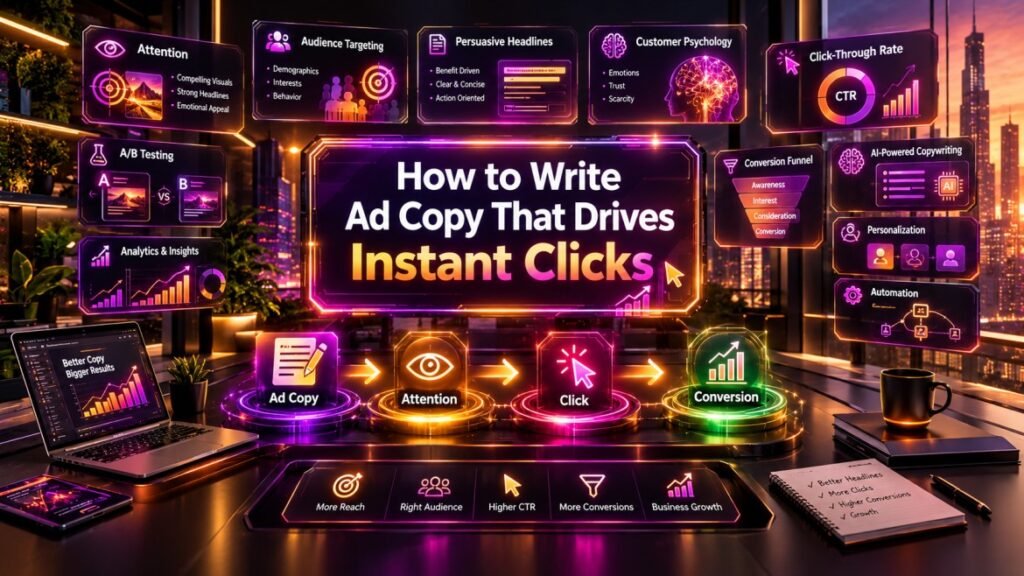
In today’s crowded digital marketplace, getting someone’s attention is harder than ever. People scroll through social media feeds, search results, websites, emails, and mobile apps every day, seeing hundreds of promotional messages. A generic advertisement can easily disappear within seconds.
That is why effective ad copy matters.
Great advertising copy does more than describe a product or service. It captures attention, creates curiosity, communicates value, builds urgency, and gives people a compelling reason to take action.
Whether you are creating Google Ads, Facebook Ads, Instagram campaigns, LinkedIn advertisements, display ads, email promotions, or landing-page headlines, the ability to write persuasive copy can directly influence clicks and conversions.
This guide explains How to Write Ad Copy that attracts attention, communicates benefits, addresses customer needs, and encourages immediate action. It also explores common mistakes, emerging trends, challenges, opportunities, and the impact of AI and digital transformation on modern advertising.
Table of Contents
What Is Ad Copy?
Ad copy is the written content used in an advertisement to persuade an audience to take a specific action.
That action could be:
- Clicking an advertisement
- Buying a product
- Signing up for a service
- Downloading an application
- Registering for an event
- Requesting a demo
- Subscribing to a newsletter
- Visiting a website
Ad copy can appear in many formats, including:
- Search advertisements
- Social media advertisements
- Display advertising
- Video advertising
- Email campaigns
- E-commerce promotions
- Landing pages
- Sponsored content
The strongest ad copy focuses on the audience rather than simply talking about the company.
Why Does Ad Copy Matter?
A visually attractive advertisement may get attention, but words often determine what happens next.
Consider two advertisements for an online productivity application.
Example A:
“Our advanced productivity platform offers powerful features for modern professionals.”
Example B:
“Finish your daily tasks faster. Organize projects, automate repetitive work, and get more done today.”
The second example focuses on outcomes rather than simply describing the product.
Effective ad copy answers an important customer question:
“Why should I click this?”
How to Write Ad Copy That Gets Clicks
Creating high-performing advertising copy is a combination of psychology, audience research, clear communication, testing, and creativity.
1. Start With Your Target Audience
Before writing a headline, understand who you are trying to reach.
Identify:
- Age group
- Location
- Interests
- Profession
- Purchasing behavior
- Problems
- Goals
- Objections
- Motivations
For example, an advertisement targeting small-business owners should not necessarily use the same language as one targeting university students.
Example
For students:
“Master Your Exams With Smarter Study Tools.”
For business owners:
“Automate Repetitive Tasks and Save Hours Every Week.”
Both advertisements promote productivity, but the messaging is adapted to different audiences.
2. Focus on the Customer’s Problem
People usually respond more strongly to advertisements that address a problem they already recognize.
Instead of starting with:
“We provide professional accounting software.”
Try:
“Still Managing Business Expenses in Spreadsheets?”
The second version immediately highlights a potential pain point.
Common Customer Problems
Your copy can address issues such as:
- High costs
- Lack of time
- Complicated processes
- Poor productivity
- Security concerns
- Difficult software
- Low sales
- Manual work
- Lack of knowledge
- Slow results
When customers recognize their problem in your advertisement, they are more likely to pay attention.
3. Highlight Benefits Instead of Features
One of the most important principles of advertising copywriting is understanding the difference between features and benefits.
A feature describes what a product has.
A benefit explains what the customer gains.
Feature
“Our application includes automated reporting.”
Benefit
“Create business reports automatically and save hours of manual work.”
The feature explains the technology.
The benefit explains the value.
Whenever possible, connect a feature to a meaningful customer outcome.
4. Write a Powerful Headline
Your headline is often the first part of an advertisement that people notice.
A strong headline should be:
- Clear
- Relevant
- Specific
- Benefit-oriented
- Easy to understand
- Appropriate for the target audience
Useful Headline Formulas
Problem + Solution
“Tired of Manual Reporting? Automate It in Minutes.”
Benefit + Audience
“Faster Project Management for Growing Teams.”
Result + Time
“Build Your First Website This Weekend.”
Curiosity
“The Simple Productivity Habit Most Teams Ignore.”
The best formula depends on the product, audience, platform, and campaign objective.
5. Create a Strong Value Proposition
Your value proposition explains why someone should choose your product or service.
A good value proposition communicates:
What you offer + Who it helps + Why it matters
For example:
“AI-powered analytics for small businesses that want faster, smarter decisions.”
This is more compelling than simply saying:
“Advanced analytics software.”
The first statement communicates relevance and value.
6. Use Specific Language
Vague claims can make advertisements feel generic.
Compare:
“Improve your business dramatically.”
with:
“Automate repetitive reports and reduce manual data entry.”
The second statement is more concrete.
Specific language helps customers understand exactly what they may gain.
Instead of:
- “Amazing results”
- “Best solution”
- “Powerful platform”
- “Great service”
Consider describing the actual outcome.
7. Add a Clear Call to Action
A Call to Action (CTA) tells users what they should do next.
Examples include:
- Start Free Trial
- Get Your Quote
- Download Now
- Book a Demo
- Shop Now
- Learn More
- Create Your Account
- Get Started Today
A CTA should match the user’s level of buying intent.
For example, someone discovering a product for the first time may respond better to:
“Explore Features”
than:
“Buy Now.”
8. Create Urgency Without Misleading Customers
Urgency can encourage people to act instead of postponing a decision.
Examples include:
- Limited-time discount
- Early-access pricing
- Registration deadline
- Seasonal promotion
- Limited availability
However, urgency should be genuine.
Avoid creating fake scarcity or misleading countdowns simply to pressure users.
Trust is increasingly important in digital marketing.
9. Use Emotional Triggers Carefully
People make decisions based on both rational and emotional factors.
Depending on your product, useful emotional drivers can include:
- Convenience
- Security
- Confidence
- Curiosity
- Achievement
- Belonging
- Saving time
- Reducing frustration
For example:
“Stop worrying about missed deadlines. Keep every project organized in one place.”
This connects the product with a reduction in stress.
10. Keep Your Copy Easy to Scan
Online users rarely read advertisements like long articles.
They scan.
Therefore, use:
- Short sentences
- Strong headlines
- Clear benefits
- Simple vocabulary
- Action-oriented language
- Concise CTAs
Remove unnecessary words.
Instead of:
“Our innovative platform has been specifically designed to provide businesses with an effective solution for managing their daily operational activities.”
Use:
“Manage daily operations faster with one simple platform.”
A Simple Ad Copy Framework
A useful structure for many advertisements is:
Attention → Problem → Benefit → Proof → Action
Example
Attention:
“Still Spending Hours Creating Reports?”
Problem:
“Manual reporting slows your team down.”
Benefit:
“Automate recurring reports and get insights faster.”
Proof:
“Built for modern business teams.”
Action:
“Start Your Free Trial.”
This framework can be adapted to different products and advertising platforms.
Ad Copy Examples
Example 1: SaaS Product
Headline:
“Automate Your Team’s Repetitive Work”
Description:
“Save time, reduce manual tasks, and keep your workflow moving with intelligent automation.”
CTA:
“Start Free”
Example 2: E-commerce
Headline:
“Upgrade Your Everyday Essentials”
Description:
“Discover practical products designed for modern living. Shop the latest collection today.”
CTA:
“Shop Now”
Example 3: Online Course
Headline:
“Learn Digital Marketing From Scratch”
Description:
“Build practical marketing skills through structured lessons, real examples, and hands-on projects.”
CTA:
“Start Learning”
How to Write Ad Copy for Different Platforms
Different advertising platforms require different approaches.
Google Search Ads
Search advertising should closely match the user’s intent.
If someone searches for:
“best accounting software for small business”
the advertisement should clearly address accounting software rather than making a generic brand statement.
Focus on:
- Search intent
- Relevant keywords
- Benefits
- Specific offers
- Strong CTAs
Facebook and Instagram Ads
Social media advertising often competes with entertainment and personal content.
The opening line or visual hook must quickly capture attention.
Use:
- Strong hooks
- Short copy
- Relatable problems
- Visual storytelling
- Clear benefits
LinkedIn Ads
LinkedIn advertising can work particularly well for B2B audiences.
Copy may focus on:
- Business outcomes
- Productivity
- Cost reduction
- Professional challenges
- Industry-specific solutions
Display Advertising
Display ads have limited space.
Keep the message extremely concise.
For example:
“Automate Reports. Save Hours.”
followed by:
“Try Free”
A/B Testing Your Ad Copy
Even experienced marketers cannot always predict which wording will perform best.
That is why A/B testing is important.
You can test:
- Headlines
- CTAs
- Benefits
- Offers
- Emotional messaging
- Long vs short copy
- Questions vs statements
Example
Version A:
“Save Time With Automation”
Version B:
“Automate Your Daily Tasks Today”
If Version B generates a better click-through rate under a controlled test, marketers can use that data to improve future campaigns.
Important Metrics to Track
Writing advertising copy is only one part of campaign optimization.
Track metrics such as:
Click-Through Rate
CTR measures the percentage of users who click an advertisement after seeing it.
Conversion Rate
Conversion rate measures how many users complete the desired action.
Cost Per Click
CPC shows how much you pay for each click in many advertising models.
Cost Per Acquisition
CPA measures the cost associated with acquiring a customer or desired conversion.
Return on Ad Spend
ROAS compares advertising revenue against advertising expenditure.
A high CTR is useful, but it does not automatically mean a campaign is profitable. The entire customer journey matters.
Common Ad Copywriting Mistakes
Writing for Everyone
Trying to appeal to everyone can make your message relevant to nobody.
Define a specific audience.
Using Too Much Jargon
Technical language can confuse people who are unfamiliar with your industry.
Use terminology only when it helps your intended audience.
Making Unsupported Claims
Statements such as “best,” “number one,” or “guaranteed results” should be supported where appropriate.
Focusing Only on the Company
Customers generally care more about their problems and desired outcomes than your company’s history.
Weak CTAs
A vague CTA can create uncertainty.
Tell users what happens next.
Ignoring the Landing Page
An advertisement and landing page should provide a consistent experience.
If an ad promises:
“50% Off Today”
but the landing page does not clearly show the offer, users may leave.
The Role of AI in Advertising Copywriting
Artificial Intelligence is changing how marketers research, create, test, and optimize advertising content.
AI tools can help marketers:
- Generate headline variations
- Summarize audience research
- Create different messaging angles
- Personalize advertisements
- Analyze campaign performance
- Identify patterns in customer behavior
- Generate content variations for testing
However, AI-generated copy should not simply be published without review.
Human marketers remain important for:
- Brand voice
- Strategic positioning
- Accuracy
- Cultural context
- Ethical considerations
- Creativity
- Customer understanding
The strongest workflow often combines AI efficiency with human judgment.
Digital Transformation and Modern Advertising
Digital transformation is fundamentally changing how businesses approach advertising.
Traditional advertising often relied on broad audiences and limited feedback.
Digital platforms provide marketers with substantially more opportunities to understand audience behavior and optimize campaigns.
Businesses can now use data to understand:
- Which audience clicked
- Which message performed best
- Which device was used
- Which campaign generated conversions
- Where customers abandoned the journey
This creates a continuous optimization cycle:
Audience Data → Ad Copy → Campaign → User Response → Analytics → Optimization
The impact of digital transformation is that advertising can become increasingly measurable, personalized, automated, and data-driven.
Future Trends in Ad Copywriting
The future of advertising will likely be shaped by AI, personalization, automation, and changing consumer expectations.
AI-Powered Personalization
Advertising systems can increasingly adapt messages based on audience characteristics, behavior, context, and intent.
Instead of one generic advertisement, marketers may use many variations designed for different audience segments.
Generative AI
Generative AI can accelerate the creation of:
- Headlines
- Product descriptions
- Ad variations
- Social media copy
- Campaign concepts
- Creative briefs
Conversational Advertising
Advertisements may increasingly connect directly with conversational interfaces.
Instead of simply clicking an ad, users could ask questions and receive personalized responses before taking action.
Predictive Optimization
AI-driven platforms may increasingly predict which messaging is likely to perform well for particular audiences.
Privacy-Centered Marketing
As consumers become more concerned about data privacy, marketers will need to balance personalization with transparency and responsible data practices.
Challenges and Opportunities
The advertising industry faces an interesting combination of challenges and opportunities.
Challenges
- Increasing competition for attention
- Ad fatigue
- Privacy restrictions
- Rising acquisition costs
- Consumer skepticism
- AI-generated content saturation
- Platform algorithm changes
Opportunities
- More precise audience targeting
- Faster creative testing
- AI-assisted campaign development
- Personalized customer experiences
- Better analytics
- Automated optimization
- New conversational advertising formats
The brands that succeed will likely be those that combine technology with genuine customer understanding.
How to Write Ad Copy: Final Checklist
Before publishing an advertisement, ask:
- Is the target audience clearly defined?
- Does the headline capture attention?
- Is the customer’s problem clear?
- Does the copy communicate a specific benefit?
- Is the message easy to understand?
- Is the claim accurate and supportable?
- Does the advertisement create a reason to act?
- Is the CTA clear?
- Does the landing page match the advertisement?
- Can the message be A/B tested?
- Are performance metrics being tracked?
If the answer is yes to most of these questions, your advertisement has a stronger foundation for performance.
Conclusion
Effective advertising is not about using the biggest words or making the loudest promises. It is about communicating the right message to the right audience at the right moment.
Learning How to Write Ad Copy requires an understanding of customer psychology, audience intent, benefits, clarity, persuasion, testing, and measurable outcomes.
AI and digital transformation are making advertising faster and more data-driven, but technology does not eliminate the need for strategic thinking. Marketers still need to understand what customers want, what problems they face, and why they should trust a particular brand.
The future of ad copywriting will likely combine human creativity with AI-assisted personalization, automated experimentation, predictive analytics, and conversational experiences.
The fundamental principle, however, will remain the same: give people a clear, relevant, and credible reason to take the next step.
Frequently Asked Questions
What makes ad copy effective?
Effective ad copy captures attention, identifies a relevant customer problem, communicates a clear benefit, builds credibility, and provides a compelling call to action.
How long should ad copy be?
There is no universal ideal length. The copy should be long enough to communicate the value proposition but concise enough to maintain attention and comply with the platform’s format.
What is the most important part of an advertisement?
The most important element depends on the platform and campaign. However, the headline or opening hook is often critical because it determines whether someone notices the advertisement.
Should I use AI to write ad copy?
AI can be useful for generating ideas, variations, and initial drafts. Human review is still important for accuracy, brand voice, strategy, originality, and compliance.
How can I improve my ad click-through rate?
Test different headlines, benefits, CTAs, offers, and audience segments. Analyze performance data and continuously improve the versions that generate meaningful engagement and conversions.
Is high CTR enough for a successful campaign?
No. A high click-through rate does not necessarily mean that a campaign is profitable. Conversion rate, CPA, revenue, customer quality, and ROAS should also be considered.