
Introduction
The digital economy is creating new opportunities for entrepreneurs who can help businesses attract customers, build brands, and increase online revenue. As companies continue investing in websites, social media, search engines, artificial intelligence, content, and online advertising, demand for professional digital marketing services is growing.
Starting an agency in 2026 does not necessarily require a large office, expensive equipment, or a huge team. A skilled founder can begin with a laptop, reliable internet connection, specialized expertise, and a clear service strategy.
If you are wondering How to Start a Digital Marketing Agency in 2026, the key is to build an agency around measurable business results rather than simply selling marketing activities.
Table of Contents
What Is a Digital Marketing Agency?
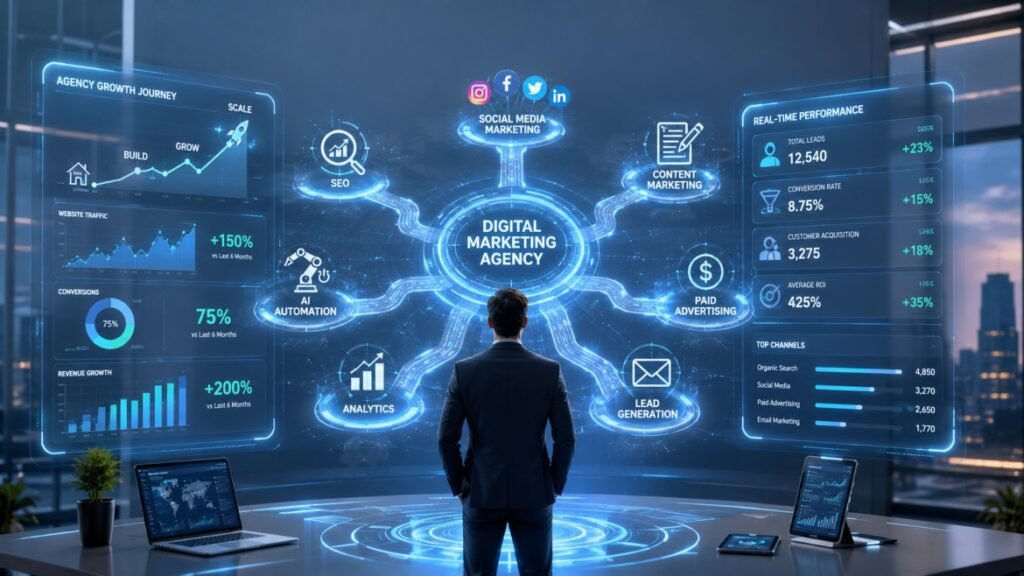
A digital marketing agency helps businesses promote their products or services through online channels. Depending on its specialization, an agency may provide:
- Search engine optimization (SEO)
- Social media marketing
- Content marketing
- Google and social media advertising
- Email marketing
- Website development
- Conversion rate optimization
- Marketing automation
- Video marketing
- AI-powered marketing services
- Analytics and performance reporting
Instead of trying to provide everything immediately, new agencies should specialize in a small number of services and develop strong expertise in a specific market.
How to Start a Digital Marketing Agency in 2026
1. Choose a Profitable Niche
The first major decision is choosing whom you want to serve.
A niche makes marketing easier because you can develop specialized knowledge, targeted offers, case studies, and messaging.
Potential niches include:
- Local restaurants
- Real estate companies
- Healthcare businesses
- E-commerce brands
- Educational institutions
- Financial services
- Technology startups
- Professional service companies
For example, instead of positioning yourself as an agency that “does digital marketing for everyone,” you could specialize in helping local real estate companies generate qualified leads through SEO, social media, and paid advertising.
2. Define Your Core Services
Avoid launching with a long list of services that you cannot deliver consistently.
Start with two or three complementary services.
For example:
SEO + Content Marketing + Local SEO
or
Social Media + Short-Form Video + Paid Advertising
or
AI Marketing Automation + Email Marketing + CRM Optimization
Your services should solve specific customer problems and have measurable outcomes.
3. Build Your Agency Brand
Your agency needs a professional digital presence before you begin contacting prospects.
Create:
- A memorable agency name
- Professional logo and visual identity
- Mobile-friendly website
- Service pages
- About page
- Portfolio or sample projects
- Contact form
- Business email
- Social media profiles
If you have limited client experience, create demonstration projects. For example, develop a sample SEO strategy for a fictional business or redesign the social media presence of a hypothetical brand.
4. Develop an Attractive Service Package
Clients generally understand packages more easily than complicated lists of individual tasks.
A simple structure could be:
Starter: SEO audit, keyword research, monthly reporting
Growth: SEO, content strategy, social media, analytics
Premium: SEO, advertising, content, automation, conversion optimization, and strategic consulting
Your pricing should consider the value delivered, complexity, client expectations, operating costs, and required expertise.
5. Use AI to Increase Productivity
AI is becoming an important part of modern marketing operations.
Agencies can use AI to assist with:
- Market research
- Content ideation
- Keyword clustering
- Customer segmentation
- Ad variations
- Data analysis
- Reporting
- Workflow automation
- Personalized email campaigns
- Social media planning
However, AI-generated material should not simply be published without human review. Strategy, brand voice, fact-checking, originality, and quality control remain essential.
Finding Your First Clients
Getting the first few clients is often more difficult than creating the agency itself.
Use Direct Outreach
Research businesses that have identifiable marketing problems. Instead of sending generic sales messages, demonstrate that you understand their situation.
For example:
“I noticed your website receives limited visibility for several local search terms. I identified three opportunities that could potentially improve your organic traffic.”
A specific observation is more persuasive than a generic promise to “increase sales.”
Build Relationships Through Content
Publish useful content on LinkedIn, your website, YouTube, or other relevant platforms.
Share:
- Marketing case studies
- SEO tips
- Advertising lessons
- Industry trends
- Website audits
- AI marketing workflows
- Before-and-after examples
Consistent educational content can gradually turn your agency into a trusted authority.
Ask for Referrals
Satisfied clients can become one of your strongest acquisition channels.
After delivering measurable results, ask clients whether they know other businesses that could benefit from your services.
Essential Technology for a Modern Agency
The future of technology will significantly influence how digital marketing agencies operate.
A lean agency can use technology for:
- CRM management
- Project management
- Marketing analytics
- SEO research
- Social scheduling
- Email automation
- Graphic design
- Video production
- AI-assisted content creation
- Customer communication
- Financial management
The objective should not be to purchase every available tool. Select technology based on actual business requirements and return on investment.
The Impact of Digital Transformation on Marketing Agencies
Digital transformation is changing how businesses communicate with customers. Companies increasingly expect marketing agencies to connect campaigns with measurable business outcomes.
This means agencies must move beyond vanity metrics such as likes and impressions.
Clients increasingly want to understand:
Traffic → Leads → Customers → Revenue
An agency that can connect marketing activity to commercial results has a stronger competitive advantage.
Future Trends for Digital Marketing Agencies
AI-Powered Marketing
Artificial intelligence will increasingly support campaign planning, customer analysis, content production, personalization, and optimization.
Search Beyond Traditional Google Results
Consumers are increasingly discovering information through AI assistants, social platforms, video platforms, marketplaces, and alternative search experiences.
Agencies will need broader search visibility strategies rather than relying exclusively on traditional SEO.
Short-Form Video
Short-form video will remain a major format for brand awareness, education, product demonstrations, and customer engagement.
First-Party Data
Privacy changes and evolving tracking technologies will increase the importance of first-party customer data and permission-based marketing.
Marketing Automation
Automated workflows will allow small agencies to manage sophisticated campaigns without requiring large teams.
Challenges You Should Expect
Starting an agency also comes with significant challenges.
High Competition
Thousands of freelancers and agencies compete for digital marketing clients. A clear niche and strong positioning can help differentiate your business.
Constantly Changing Platforms
Search algorithms, advertising systems, social media features, and AI technologies change rapidly. Continuous learning is essential.
Client Retention
Winning a client is only the beginning. Agencies must communicate clearly, demonstrate progress, and connect marketing activity to business objectives.
Managing Cash Flow
Revenue can fluctuate, especially during the early stages. Keep operating expenses controlled and establish clear payment terms.
Opportunities in 2026 and Beyond
The biggest opportunity may be the combination of specialized marketing expertise and AI-enabled execution.
A small agency can potentially compete with larger firms by using automation to reduce repetitive work while spending more time on strategy and client relationships.
Emerging opportunities include:
- AI marketing consulting
- Local SEO
- E-commerce growth marketing
- Personal branding
- Video marketing
- Marketing automation
- Conversion optimization
- Performance advertising
- Content strategy
- AI search optimization
- Data-driven customer acquisition
A Simple 90-Day Launch Plan
Days 1–30: Build
- Select your niche
- Define your service packages
- Create your brand
- Launch your website
- Prepare sample work
- Set up business systems
Days 31–60: Market
- Build a prospect list
- Start personalized outreach
- Publish useful content
- Network with business owners
- Offer strategic audits
- Collect testimonials from early projects
Days 61–90: Scale
- Improve your sales process
- Document repeatable workflows
- Introduce automation
- Build case studies
- Focus on profitable services
- Develop referral partnerships
Conclusion
Building an agency in 2026 is less about having a massive team and more about having a valuable specialization, efficient systems, strong technology, and the ability to generate measurable results.
If you are serious about How to Start a Digital Marketing Agency in 2026, begin small, choose a clear niche, solve real customer problems, use AI intelligently, and continuously improve your expertise.
The impact of digital transformation will continue creating opportunities for agencies that can combine creativity, data, technology, and business strategy. Entrepreneurs who adapt to the future of technology rather than resisting it can build lean, scalable, and highly competitive digital marketing businesses.
SEO Keywords
- How to Start a Digital Marketing Agency in 2026
- digital marketing agency
- start a marketing agency
- digital marketing business
- AI marketing agency
- digital transformation
- future of technology
- digital marketing trends 2026
- marketing automation
- SEO agency
- online marketing business