
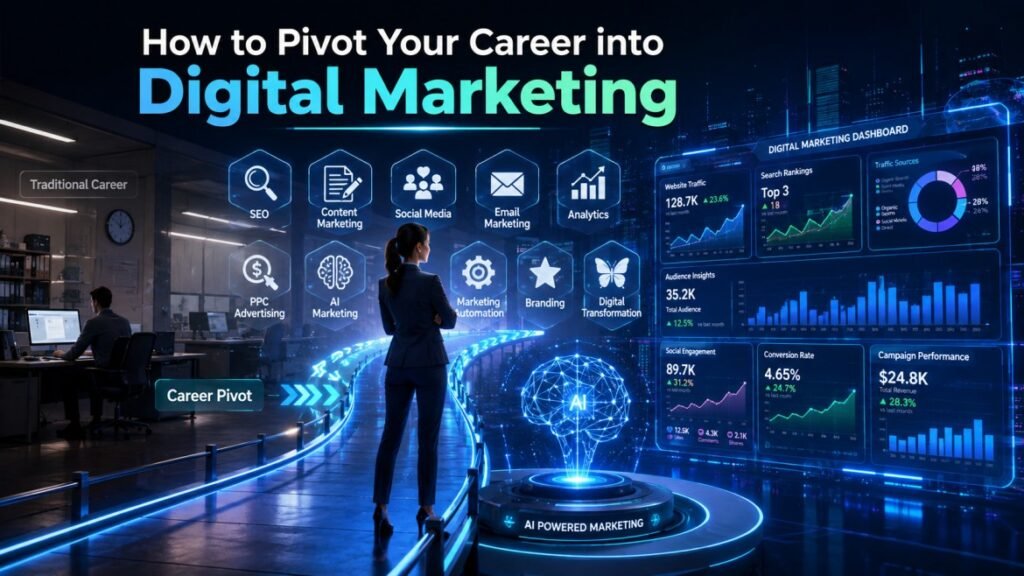
How to Pivot Your Career into Digital Marketing Changing careers can feel risky, especially when you have already invested years building experience in another field. However, the growth of online businesses, social platforms, e-commerce, artificial intelligence, and data-driven advertising has created new opportunities for professionals from almost every background.
If you are considering How to Pivot Your Career into Digital Marketing, the good news is that you do not necessarily need to start from zero. Your existing communication, analytical, sales, technology, project management, or industry knowledge can become a valuable advantage.
This guide explains how to make the transition strategically, what skills to develop, which challenges to expect, and how emerging technology may shape your new career.
Table of Contents
Why Consider a Career in Digital Marketing?
How to Pivot Your Career into Digital Marketing Digital marketing has become an important part of modern business strategy. Companies need professionals who can attract customers, build online communities, create content, improve search visibility, generate leads, and measure marketing performance.
The expansion of digital transformation has increased the demand for people who understand both marketing fundamentals and digital platforms.
Some popular career paths include:
- SEO Specialist
- Content Marketing Specialist
- Social Media Manager
- Digital Marketing Executive
- PPC Specialist
- Email Marketing Specialist
- Performance Marketing Analyst
- Marketing Automation Specialist
- Digital Marketing Consultant
- Growth Marketing Specialist
For example, someone with a sales background may transition into performance marketing because they already understand customer psychology and conversion. Similarly, a technical professional may find SEO analytics, marketing automation, or marketing technology particularly suitable.
How to Pivot Your Career into Digital Marketing Successfully
A successful career transition requires more than completing a few online courses. You need a structured approach that combines education, practical experience, portfolio development, and networking.
1. Identify Your Transferable Skills
Start by analyzing what you already know.
You may already possess skills that digital marketing employers value, such as:
- Communication
- Research
- Data analysis
- Customer service
- Project management
- Sales
- Writing
- Presentation
- Problem-solving
- Technology knowledge
Instead of treating your previous career as irrelevant, identify how it connects with marketing.
Example: A software professional may move toward technical SEO, marketing analytics, or SaaS content marketing. A teacher could transition into content creation, social media education, or online course marketing.
2. Learn the Digital Marketing Fundamentals
You do not need to master everything simultaneously. Build your foundation around the major areas of digital marketing.
Focus on:
- Search Engine Optimization (SEO)
- Content marketing
- Social media marketing
- Email marketing
- Search advertising
- Analytics
- Conversion rate optimization
- Marketing automation
- AI-assisted marketing
Understand the purpose of each discipline and how they work together.
For instance, SEO can bring organic traffic, content can educate visitors, email marketing can nurture prospects, and conversion optimization can turn visitors into customers.
3. Choose a Specialization
Trying to become an expert in every marketing discipline can slow down your progress.
After learning the fundamentals, choose one or two areas that match your strengths.
If You Like Writing
Consider:
- Content marketing
- SEO content
- Copywriting
- Blogging
- Email marketing
If You Like Data
Consider:
- Marketing analytics
- Performance marketing
- Conversion optimization
- SEO analytics
If You Like Creativity
Consider:
- Social media
- Video marketing
- Brand marketing
- Creative campaigns
If You Like Technology
Consider:
- Marketing automation
- Technical SEO
- CRM platforms
- AI marketing tools
- Marketing technology
Specialization can make your career transition easier because employers can understand exactly what value you offer.
Build a Portfolio Before Applying for Jobs
One of the biggest mistakes career changers make is collecting certificates without creating evidence of their abilities.
A portfolio can demonstrate what you can actually do.
Create practical projects such as:
- An SEO-optimized website
- A keyword research report
- A content marketing strategy
- A social media campaign
- A sample Google Ads campaign
- An email marketing sequence
- A competitor analysis
- A website SEO audit
- A marketing performance dashboard
You can create projects for fictional businesses if you do not yet have clients.
For example, choose a local restaurant and create a hypothetical digital marketing strategy covering SEO, Instagram content, Google Business Profile optimization, paid advertising, and customer reviews.
This gives you something concrete to discuss during interviews.
Use AI to Accelerate Your Career Transition
Artificial intelligence is changing how marketers research, create, analyze, and optimize campaigns.
Modern marketers can use AI to assist with:
- Keyword research
- Content ideation
- Audience analysis
- Ad copy variations
- Email personalization
- Competitor research
- Customer segmentation
- Data interpretation
- Campaign optimization
- Content repurposing
However, AI should be treated as an assistant rather than a replacement for marketing expertise.
Human judgment remains important for strategy, brand voice, creativity, fact-checking, customer understanding, and ethical decision-making.
The future of technology will likely make AI capabilities increasingly important for digital marketers, making AI literacy a useful career advantage.
Gain Real-World Experience
Once you have developed foundational skills, look for opportunities to apply them.
You could:
- Volunteer to manage marketing for a small business
- Help a nonprofit with social media
- Start your own website
- Freelance for small companies
- Create marketing campaigns for personal projects
- Assist an experienced marketer
- Take internships or contract assignments
Even small projects can provide valuable experience.
A portfolio showing measurable improvements is particularly powerful. Instead of saying, “I know SEO,” you can demonstrate how you improved rankings, organic traffic, engagement, leads, or conversions.
Network With Digital Marketing Professionals
Career transitions become easier when you build relationships within your target industry.
Use professional networking platforms, marketing communities, webinars, conferences, and industry events to connect with practitioners.
Ask professionals about:
- Their career journey
- Skills employers currently value
- Common beginner mistakes
- Useful tools
- Emerging marketing roles
- Portfolio expectations
Networking can also uncover opportunities that are never publicly advertised.
Update Your Resume and LinkedIn Profile
Your previous career should not disappear from your resume.
Instead, reposition relevant experience around your new career direction.
For example:
Before:
“Managed customer support operations.”
Better for marketing:
“Analyzed customer feedback and behavioral patterns to identify recurring customer needs and improve communication strategies.”
The objective is to connect previous accomplishments with marketing-related capabilities without exaggerating your experience.
Challenges You May Face
Career switching is exciting, but it is not always easy.
Lack of Direct Experience
Employers may prefer candidates with marketing experience. Your portfolio, freelance projects, internships, and personal campaigns can help bridge this gap.
Too Many Tools
Digital marketing contains hundreds of platforms and technologies. Avoid trying to learn everything.
Master the fundamentals first and learn tools according to your specialization.
Constant Industry Changes
Search algorithms, social platforms, advertising technologies, and AI tools continue to evolve.
Continuous learning is therefore essential.
Starting at a Lower Level
Depending on your previous career, you may initially need to accept a junior, specialist, freelance, or contract position.
Think of the first role as an entry point rather than a permanent step backward.
Opportunities in the Future of Digital Marketing
The impact of digital transformation will continue to influence marketing departments across industries.
Several areas are likely to create new opportunities.
AI-Powered Marketing
AI will increasingly support personalization, predictive analytics, campaign optimization, and content workflows.
First-Party Data
As privacy expectations and tracking limitations evolve, businesses will place greater emphasis on customer relationships and first-party data.
Search Beyond Traditional Search Engines
Consumers increasingly discover information through social platforms, video platforms, AI assistants, marketplaces, and other digital channels.
Marketers will need broader search visibility strategies.
Marketing Automation
Automation can help companies manage customer journeys, lead nurturing, segmentation, and personalized communications at scale.
Short-Form Video
Short-form video is likely to remain an important channel for attention, brand discovery, education, and product promotion.
A Practical 90-Day Career Pivot Plan
If you want to know How to Pivot Your Career into Digital Marketing, create a realistic transition timeline.
Days 1–30: Learn
- Study digital marketing fundamentals.
- Learn SEO, content, social media, analytics, and advertising basics.
- Choose a potential specialization.
- Explore commonly used marketing platforms.
Days 31–60: Practice
- Build two or three practical projects.
- Create your portfolio.
- Start publishing useful marketing content.
- Experiment with AI-assisted workflows.
- Analyze real marketing campaigns.
Days 61–90: Launch
- Update your resume and LinkedIn profile.
- Start applying for relevant positions.
- Contact marketing professionals.
- Look for freelance or internship opportunities.
- Continue improving your portfolio.
- Track applications and interview feedback.
This approach transforms a career change from an uncertain idea into a measurable project.
Final Thoughts
How to Pivot Your Career into Digital Marketing is not simply about learning social media or creating advertisements. It is about developing a combination of marketing knowledge, technology skills, analytical thinking, creativity, and practical experience.
Your previous career can become an asset rather than an obstacle. Identify your transferable skills, select a specialization, build demonstrable projects, learn AI tools, develop industry connections, and gradually gain real-world experience.
As businesses continue investing in digital transformation, professionals who can combine human creativity with technology and data-driven decision-making will have significant opportunities.
The best time to begin your transition is not when you feel completely ready. Start learning, build something, measure the results, and improve continuously.