
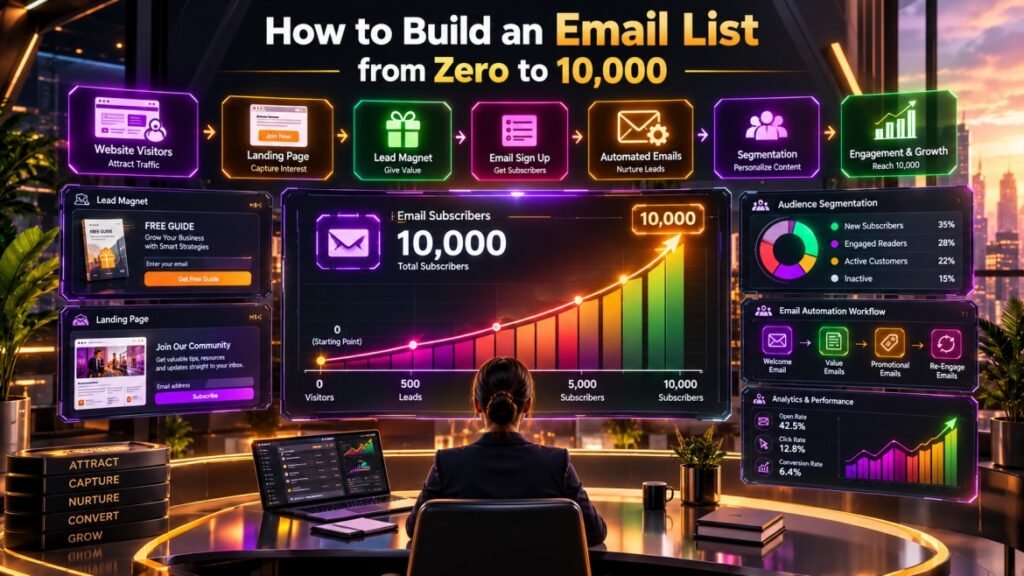
Starting an email list from zero can feel like a difficult task. You may have a website, social media profiles, valuable content, or an online business, but none of these automatically gives you a direct relationship with your audience. An email list changes that by creating a communication channel that you can build and nurture over time.
Learning How to Build an Email List is particularly valuable in an environment where social-media algorithms, advertising costs, and digital platforms constantly change. Unlike followers on a social network, subscribers on an email list can become part of a permission-based audience that you can communicate with directly.
Reaching 10,000 subscribers is not simply a numbers game. The objective should be to attract the right people, provide genuine value, and gradually convert subscribers into engaged readers, customers, clients, or community members.
This guide explains a practical path from 0 to 10,000 email subscribers, including lead magnets, landing pages, content marketing, automation, promotion, analytics, challenges, and future opportunities.
Table of Contents
Why Build an Email List?
Email remains one of the most useful channels for maintaining a long-term relationship with an audience.
A social-media post can disappear from a user’s feed within hours. An email, however, reaches a person’s inbox and can be part of an organized communication strategy.
An email list can help you:
- Build a direct relationship with your audience
- Promote products and services
- Distribute blog content
- Generate repeat website traffic
- Nurture potential customers
- Build brand recognition
- Conduct surveys and collect feedback
- Launch new products
- Create personalized campaigns
Email vs. Social Media
Social platforms are excellent for discovery and audience growth, while email can be powerful for retention and relationship building.
A balanced digital strategy can therefore look like:
Social Media → Website → Email Subscription → Email Relationship → Conversion
This creates an ecosystem rather than depending entirely on a single platform.
Step 1: Define Who You Want to Attract
Before collecting thousands of email addresses, determine who should actually join your list.
A large but irrelevant list may generate less business value than a smaller, highly engaged audience.
Define Your Ideal Subscriber
Consider:
- What problem do they have?
- What information are they searching for?
- What outcome do they want?
- What type of content do they consume?
- What products or services might interest them?
- Why would they voluntarily give you their email address?
Example
Suppose you operate a website about digital marketing.
Instead of targeting “everyone interested in marketing,” you could focus on:
Beginners who want practical digital marketing strategies for growing a small online business.
This narrower audience makes your content and lead-generation strategy much easier to design.
Step 2: Create a Valuable Lead Magnet
One of the most effective ways to encourage visitors to subscribe is to offer something useful in exchange for their email address.
This is commonly called a lead magnet.
Examples include:
- Free ebook
- Checklist
- Templates
- Case study
- Industry report
- Mini-course
- Resource guide
- Spreadsheet
- Email course
- Webinar
- Free toolkit
- Downloadable PDF
The lead magnet should solve a specific problem rather than simply provide generic information.
Example
Instead of:
“Subscribe to Our Newsletter”
try:
“Download the 30-Point SEO Checklist for New Websites.”
The second offer communicates a clear benefit.
Step 3: Build a High-Converting Landing Page
Your landing page is where visitors decide whether to become subscribers.
A good landing page should communicate three things quickly:
- What is being offered?
- Who is it for?
- What benefit will the subscriber receive?
Essential Landing Page Elements
Include:
- Strong headline
- Short benefit-focused description
- Relevant visual
- Email form
- Clear call-to-action
- Trust elements
- Privacy information where appropriate
Avoid overwhelming visitors with unnecessary navigation and excessive text.
Example CTA
Instead of:
Submit
use:
Get My Free SEO Checklist
The second CTA communicates the expected outcome.
Step 4: Add Signup Opportunities Across Your Website
A single signup form on your homepage is rarely enough.
Place relevant subscription opportunities throughout your website.
Potential locations include:
- Homepage
- Blog posts
- Sidebar
- Footer
- Resource pages
- Landing pages
- About page
- Exit-intent experiences
- Content upgrades
However, avoid aggressive pop-ups that damage the user experience.
The best signup opportunity should feel connected to the content the visitor is already consuming.
Step 5: Use Content Marketing to Attract Subscribers
Content can become the engine that continuously feeds your email list.
Create content around problems your target audience is actively trying to solve.
Potential formats include:
- Blog articles
- Tutorials
- YouTube videos
- Short-form videos
- Podcasts
- Case studies
- Infographics
- Research reports
- Social posts
At the end of relevant content, provide a logical next step.
Example
A blog post titled:
“10 SEO Mistakes New Bloggers Make”
could promote a related:
“Free SEO Audit Checklist.”
The visitor receives additional value while you gain a potential subscriber.
Step 6: Create a Welcome Email Sequence
Getting a subscriber is only the beginning.
You need to establish a relationship immediately.
A basic welcome sequence could contain:
Email 1: Welcome
Deliver the promised lead magnet and introduce your brand.
Email 2: Quick Win
Provide one practical strategy the subscriber can implement immediately.
Email 3: Education
Explain a common problem and how to approach it.
Email 4: Case Study
Show how a strategy works in a real-world situation.
Email 5: Next Step
Introduce your product, service, community, or another valuable resource.
The objective is to establish trust before aggressively selling.
Step 7: Promote Your Newsletter Everywhere
If your only acquisition strategy is organic website traffic, reaching 10,000 subscribers can take a long time.
Expand your distribution.
Consider:
- YouTube
- X
- Online communities
- Podcasts
- Webinars
- Guest articles
- Partnerships
- Search engines
- Referral programs
Every channel should have a clear path toward your website or signup page.
Step 8: Build a Referral System
Your existing subscribers can become an important source of new subscribers.
Create a referral incentive such as:
“Invite three friends and receive our premium marketing template pack.”
A referral strategy can transform your subscribers from passive readers into active growth participants.
Why Referrals Work
People are often more willing to explore content recommended by someone they already know.
However, referral incentives should be transparent and should not encourage spam or unwanted messages.
Step 9: Segment Your Audience
A 10,000-person list is not necessarily one homogeneous audience.
Different subscribers may have different interests.
You can segment users based on:
- Content preferences
- Signup source
- Purchase history
- Engagement
- Geographic region
- Business type
- Interests
- Customer lifecycle stage
Example
A technology website could separate subscribers into:
- AI enthusiasts
- Software developers
- Digital marketers
- Cybersecurity professionals
- Students
- Business owners
Relevant segmentation allows you to deliver more useful content.
Step 10: Personalize Your Emails
Personalization goes beyond adding someone’s first name.
You can personalize based on what subscribers actually do.
For example:
If someone repeatedly reads your articles about AI automation, you could send them more content related to AI tools and workflows.
Behavior-based personalization can make email communication more relevant while reducing unnecessary messages.
The 0-to-10,000 Email List Growth Roadmap
Reaching 10,000 subscribers becomes easier when you divide the target into stages.
Stage 1: 0–100 Subscribers
Focus on:
- Creating your lead magnet
- Setting up signup forms
- Publishing useful content
- Personally sharing your subscription page
- Testing your messaging
Your objective is learning, not scale.
Stage 2: 100–1,000 Subscribers
Now identify what is working.
Analyze:
- Signup conversion rate
- Traffic sources
- Lead magnet performance
- Email engagement
- Content performance
Double down on channels producing relevant subscribers.
Stage 3: 1,000–5,000 Subscribers
At this stage, introduce more systematic growth.
Consider:
- SEO
- Partnerships
- Webinars
- Referral campaigns
- Content upgrades
- Automated email sequences
- Social-media distribution
Automation becomes increasingly important.
Stage 4: 5,000–10,000 Subscribers
The priority shifts from simply acquiring subscribers to improving subscriber quality and lifetime value.
Focus on:
- Segmentation
- Personalization
- Engagement
- Conversion
- Retention
- Deliverability
- Automated journeys
A list of 10,000 engaged subscribers can be significantly more valuable than a much larger list with poor engagement.
Important Email Marketing Metrics
Growing an email list without measuring performance is like driving without a dashboard.
Track metrics such as:
Subscriber Growth Rate
Measures how quickly your list is expanding.
Signup Conversion Rate
Shows how effectively website visitors become subscribers.
Open Rate
Provides an indication of how subscribers interact with email subject lines and messages, although modern email privacy features can make this metric less precise.
Click-Through Rate
Measures how many recipients click links within an email.
Conversion Rate
Measures the percentage of recipients who complete the desired action.
Unsubscribe Rate
Helps identify whether your content frequency or relevance needs improvement.
List Quality
Monitor inactive subscribers, invalid addresses, spam complaints, and engagement trends.
Common Mistakes to Avoid
Buying Email Lists
Never build your audience primarily by purchasing random email databases.
Purchased lists often contain irrelevant or outdated contacts and can create serious deliverability and compliance problems.
Sending Too Many Emails
More emails do not automatically mean more engagement.
Focus on relevance and value.
Ignoring Mobile Users
A large portion of email consumption occurs on mobile devices. Your emails should therefore be easy to read on smaller screens.
Weak Subject Lines
A great email can still fail if the subject line does not communicate a compelling reason to open it.
No Clear CTA
Every promotional email should have a clear purpose.
Ask yourself:
What should the reader do next?
Focusing Only on Subscriber Count
10,000 subscribers sounds impressive, but engagement and business outcomes matter more.
Challenges in Growing an Email List
Building an audience organically requires patience.
Increasing Competition
More websites and creators are competing for attention.
Rising Content Volume
AI has made content creation faster, which means audiences may face an overwhelming amount of information.
Privacy Expectations
Consumers increasingly expect businesses to handle their personal information responsibly.
Deliverability
Email providers continuously improve systems for identifying unwanted or low-quality messages.
Audience Fatigue
People receive countless marketing messages every day.
Therefore, businesses need to create emails that are useful rather than merely promotional.
Future Trends in Email Marketing
The future of technology will influence how businesses collect, analyze, personalize, and communicate with subscribers.
AI-Powered Personalization
AI can help marketers analyze subscriber behavior and recommend relevant content, products, and communication sequences.
Predictive Segmentation
Machine-learning systems can potentially identify groups of subscribers based on behavior and engagement patterns.
Automated Content Workflows
AI can assist with subject-line ideas, content variations, segmentation, testing, and campaign analysis.
Interactive Emails
Email experiences may increasingly include interactive elements that allow users to engage without immediately leaving their inbox.
Privacy-Centered Marketing
As consumers become more conscious of data privacy, transparent consent and responsible data management will become increasingly important.
The digital transformation of marketing is therefore not about sending more messages. It is about creating more relevant customer experiences.
Opportunities for Businesses and Creators
A strong email list can become a valuable business asset.
It can support:
- Digital product launches
- Online courses
- Consulting services
- Affiliate marketing
- Ecommerce
- Membership communities
- Events
- Sponsorships
- Premium newsletters
- SaaS businesses
For creators, an email audience can also reduce dependence on social platforms.
For businesses, it can create a long-term communication channel for customer education and retention.
How AI Is Changing Email List Growth
The impact of it—particularly AI and automation—can be seen across nearly every part of email marketing.
AI can assist marketers with:
- Audience research
- Lead-magnet ideas
- Content generation
- Subject-line experimentation
- Customer segmentation
- Campaign analysis
- Personalization
- Workflow automation
- Content recommendations
But AI should support marketing strategy rather than replace human judgment.
A generic AI-generated email sent to thousands of people may be less effective than a carefully designed message based on genuine customer needs.
A Practical 10,000-Subscriber Strategy
If you are starting from zero, use this framework:
Month 1: Foundation
- Define your audience
- Create one strong lead magnet
- Build a landing page
- Install signup forms
- Write a welcome sequence
Months 2–3: Content
- Publish valuable articles
- Create social content
- Promote your lead magnet
- Test different CTAs
- Monitor conversions
Months 4–6: Expansion
- Introduce partnerships
- Launch referral campaigns
- Create webinars
- Improve SEO
- Develop additional lead magnets
Beyond 6 Months: Optimization
- Segment subscribers
- Personalize campaigns
- Automate workflows
- Remove inactive contacts appropriately
- Improve conversion rates
- Experiment with new acquisition channels
The actual timeline will vary considerably depending on niche, traffic, offer quality, distribution, and conversion rate.
Final Thoughts
Knowing How to Build an Email List is ultimately about building a relationship rather than collecting email addresses.
Start with a clearly defined audience and create something genuinely valuable enough that people willingly exchange their email address for it. Then use useful content, consistent communication, segmentation, automation, and responsible marketing practices to develop that relationship.
The journey from zero to 10,000 subscribers will not happen through one viral post or one clever signup form. It is usually the result of many small improvements across content, acquisition, conversion, retention, and engagement.
As the future of technology continues to reshape digital marketing and AI accelerates digital transformation, email marketing will also evolve. The businesses and creators most likely to benefit will be those that combine automation and AI with relevance, trust, creativity, privacy, and genuine customer value.
The real goal should not simply be 10,000 subscribers. The goal should be 10,000 people who actually want to hear from you.