
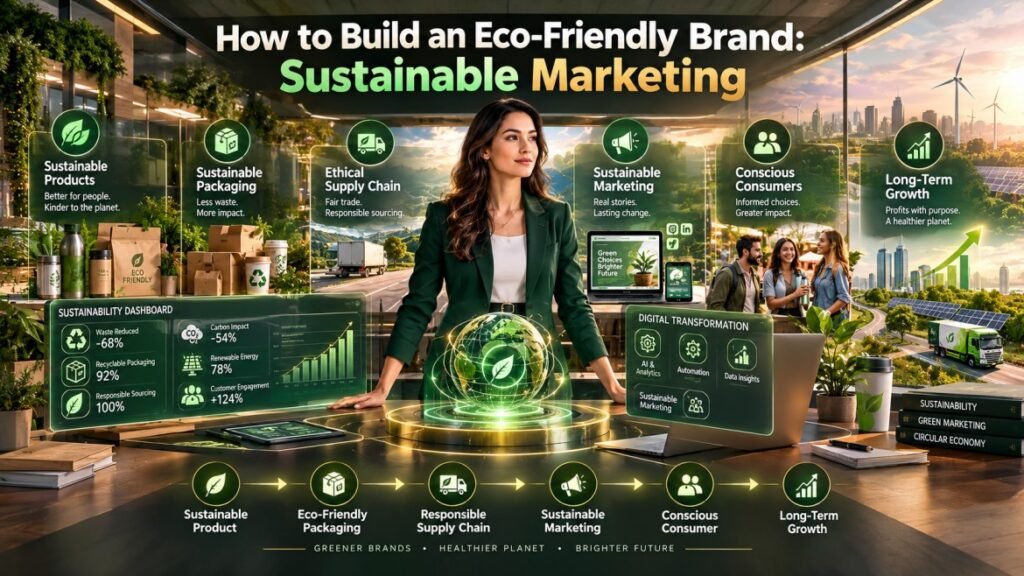
Consumers are becoming more conscious of how products are made, packaged, delivered, and marketed. As environmental concerns influence purchasing decisions, businesses have an opportunity to build brands that are not only commercially successful but also more responsible toward the planet.
This shift has made sustainable marketing an increasingly important business strategy. However, building an eco-friendly brand involves much more than putting a green logo on a product or describing a company as environmentally responsible. It requires genuine changes in products, operations, packaging, communication, and customer relationships.
If you are wondering How to Build an Eco-Friendly Brand, the starting point is to connect sustainability with your actual business practices. Your marketing should communicate what your company genuinely does rather than making environmental promises that cannot be supported.
This guide explains how businesses can develop an eco-friendly brand, create sustainable marketing campaigns, avoid greenwashing, use technology effectively, and prepare for the changing expectations of environmentally conscious consumers.
Table of Contents
What Is an Eco-Friendly Brand?
An eco-friendly brand is a business that considers its environmental impact while developing products, delivering services, operating its organization, and communicating with customers.
Sustainability can influence areas such as:
- Product materials
- Manufacturing
- Packaging
- Transportation
- Energy consumption
- Waste management
- Supply chains
- Digital operations
- Marketing activities
- Product lifecycle
An eco-friendly brand does not necessarily have to be perfect. The objective is to identify meaningful areas where environmental impact can be reduced and then communicate those efforts honestly.
How to Build an Eco-Friendly Brand
The process begins with understanding where your business has the greatest environmental impact.
1. Define Your Sustainability Mission
Before creating marketing campaigns, establish what sustainability means for your business.
Ask questions such as:
- Which environmental problem does the business want to address?
- Can the product reduce waste or resource consumption?
- Which materials can be improved?
- Can packaging be reduced?
- Can suppliers follow stronger environmental practices?
- How will sustainability progress be measured?
A clear mission prevents sustainability from becoming nothing more than a marketing slogan.
Example
A clothing company might focus on:
“Reducing textile waste through durable products, responsible materials, and repair-oriented customer programs.”
This is more meaningful than simply describing the brand as “green.”
2. Evaluate Your Product Lifecycle
A product’s environmental impact can occur at many stages.
Consider its journey from raw materials to disposal:
Raw Materials → Manufacturing → Packaging → Transportation → Customer Use → End of Life
Analyze each stage and identify opportunities for improvement.
For example, a consumer-product company might:
- Reduce unnecessary packaging.
- Use recycled or responsibly sourced materials.
- Improve product durability.
- Offer repair services.
- Design products for easier recycling.
- Reduce unnecessary transportation.
Lifecycle thinking can help companies find sustainability improvements that marketing alone cannot achieve.
3. Choose Sustainable Packaging
Packaging is one of the most visible parts of a product experience.
Businesses can explore:
- Recycled materials
- Recyclable packaging
- Reusable containers
- Minimal packaging
- Paper-based alternatives
- Compostable options where appropriate
However, companies should avoid automatically assuming that an alternative material is environmentally better in every situation.
Consider the complete lifecycle, including production, transportation, durability, recycling infrastructure, and disposal.
4. Build a Responsible Supply Chain
An eco-friendly brand cannot focus only on its storefront while ignoring its suppliers.
Review areas such as:
- Supplier environmental practices
- Manufacturing processes
- Material sourcing
- Transportation
- Energy consumption
- Waste management
- Labor and ethical standards
Businesses can work with suppliers to establish measurable sustainability expectations.
This also creates stronger evidence for sustainability claims used in marketing.
What Is Sustainable Marketing?
Sustainable marketing involves promoting products and services while considering environmental and broader social impacts.
It goes beyond advertising.
A sustainable marketing strategy can include:
- Honest environmental communication
- Responsible packaging
- Digital-first campaigns
- Reduced marketing waste
- Sustainable product education
- Transparent sourcing information
- Long-term customer relationships
The objective is to align marketing messages with actual business practices.
Sustainable Marketing Strategies
Tell the Truth About Your Environmental Efforts
Transparency is one of the most important elements of sustainable marketing.
Instead of saying:
“Our product is completely eco-friendly.”
provide specific information:
“Our packaging contains 80% recycled material, and we are working toward increasing that percentage.”
Specific claims are easier for customers to understand and evaluate.
Avoid Greenwashing
Greenwashing occurs when a company creates an exaggerated or misleading impression about its environmental performance.
Common examples include:
- Vague claims such as “100% green”
- Unsubstantiated environmental promises
- Green imagery without meaningful sustainability practices
- Highlighting one small improvement while ignoring major environmental problems
- Using environmental terminology without explaining what it means
If your company has limitations, acknowledge them.
Honest communication can be more credible than presenting an unrealistic image of environmental perfection.
Use Educational Content
Sustainable marketing should help customers understand why environmental improvements matter.
Brands can publish:
- Blog articles
- Tutorials
- Product guides
- Infographics
- Videos
- Sustainability reports
- Frequently asked questions
- Behind-the-scenes content
For example, a furniture company could explain how different wood sources affect sustainability and why product durability matters.
Educational content can build authority while helping customers make more informed decisions.
Use Digital Marketing to Reduce Physical Waste
Digital transformation has changed how businesses communicate with customers.
Instead of relying heavily on printed brochures, catalogs, and promotional materials, companies can use:
- Email marketing
- Social media
- Websites
- Digital catalogs
- QR codes
- Online product guides
- Digital customer communities
Digital marketing is not automatically environmentally neutral because websites, cloud infrastructure, devices, and data centers consume energy.
Nevertheless, businesses can consider efficiency when designing their digital operations.
For example:
- Optimize website images.
- Reduce unnecessary page elements.
- Improve website performance.
- Use efficient hosting infrastructure.
- Avoid excessive digital advertising waste.
- Create reusable digital content.
This connects sustainability with digital transformation rather than treating the two as separate initiatives.
Build an Eco-Friendly Brand Identity
Brand identity communicates what a company stands for.
Visual elements can support sustainability, but they should reinforce genuine business practices.
Consider:
Colors
Natural colors such as earth tones, green, beige, brown, and neutral shades are commonly associated with environmental themes.
However, sustainability does not require a specific color palette.
Typography
Clean, readable typography can communicate simplicity and transparency.
Photography
Show real products, materials, production processes, employees, suppliers, and sustainability initiatives instead of relying entirely on generic nature imagery.
Brand Voice
Use language that is:
- Transparent
- Informative
- Responsible
- Evidence-based
- Customer-focused
Avoid exaggerated environmental language.
Create Sustainable Customer Experiences
Sustainability can become part of the entire customer journey.
For example, an online retailer could offer:
Product Discovery → Sustainability Information → Purchase → Low-Waste Packaging → Delivery → Product Care → Repair/Reuse → Recycling
This approach extends sustainability beyond the initial transaction.
Businesses can also encourage customers to:
- Repair products
- Reuse packaging
- Recycle responsibly
- Purchase only what they need
- Choose longer-lasting products
Measure Your Sustainability Performance
Marketing claims should be supported by measurable information.
Businesses can track indicators such as:
- Packaging reduction
- Recycled material usage
- Energy consumption
- Waste reduction
- Transportation emissions
- Product returns
- Product lifespan
- Recycling participation
Measurements make sustainability programs more credible and help businesses identify areas for improvement.
The Role of Technology in Sustainable Marketing
Technology can support sustainability in several ways.
Artificial Intelligence
AI can help companies analyze customer behavior, forecast demand, optimize inventory, and identify inefficiencies.
Better demand forecasting can potentially reduce overproduction and unnecessary inventory.
Data Analytics
Businesses can analyze operational and customer data to identify waste and improve resource allocation.
Cloud Technology
Cloud-based systems can support collaboration and reduce dependence on some physical infrastructure, although cloud computing itself has an environmental footprint that businesses should consider.
Automation
Automation can improve operational efficiency and reduce repetitive processes.
The impact of it depends on how technology is implemented. Technology alone does not make a company sustainable; its environmental value comes from using it to improve measurable outcomes.
Sustainable Marketing Examples
Different industries can apply sustainable marketing in different ways.
Fashion
A fashion company could promote:
- Durable clothing
- Repair programs
- Responsible materials
- Take-back initiatives
- Transparent sourcing
Food
A food company could focus on:
- Responsible sourcing
- Food-waste reduction
- Efficient packaging
- Local supply chains where appropriate
- Clear product information
Technology
A technology company could highlight:
- Energy-efficient products
- Device repairability
- Longer software support
- Recycling programs
- Responsible packaging
Beauty
A beauty company could explore:
- Refillable packaging
- Responsible ingredient sourcing
- Reduced packaging
- Recycling initiatives
- Transparent product information
Challenges of Building an Eco-Friendly Brand
Higher Initial Costs
Sustainable materials, efficient technology, responsible suppliers, and improved packaging can require additional investment.
However, businesses should evaluate sustainability through long-term value rather than looking only at initial costs.
Supply Chain Complexity
It can be difficult to verify sustainability claims across international supply chains.
Companies need reliable suppliers, documentation, auditing, and measurable standards.
Consumer Skepticism
Customers may question environmental claims because of widespread greenwashing.
Transparency and evidence are therefore critical.
Measuring Environmental Impact
Some environmental benefits are difficult to measure accurately.
Businesses should define clear metrics and explain their methodology where appropriate.
Balancing Sustainability and Profitability
An eco-friendly strategy must remain commercially viable.
Businesses need to identify sustainability improvements that simultaneously support customer value, efficiency, resilience, or long-term competitiveness.
Opportunities for Eco-Friendly Brands
Sustainability also creates significant business opportunities.
Customer Loyalty
Customers who identify strongly with a brand’s values may develop deeper relationships with companies that demonstrate authentic commitments.
Product Innovation
Environmental challenges can inspire new products, materials, packaging concepts, and business models.
Operational Efficiency
Reducing energy use, material waste, and unnecessary transportation can sometimes lower operating costs.
Brand Differentiation
A credible sustainability strategy can help a company stand apart in crowded markets.
New Business Models
Companies can explore:
- Product-as-a-service
- Repair programs
- Refurbishment
- Refill systems
- Product take-back
- Subscription models
- Resale platforms
Future Trends in Sustainable Marketing
The future of sustainable marketing is likely to become increasingly data-driven and transparent.
Greater Demand for Proof
Customers may increasingly expect brands to support environmental claims with measurable evidence.
AI-Powered Sustainability
AI could help companies optimize inventory, logistics, personalization, content production, and resource consumption.
Circular Economy Marketing
Brands may increasingly promote repair, reuse, refurbishment, resale, and recycling rather than focusing exclusively on new-product purchases.
Sustainable Digital Experiences
Companies will likely pay more attention to the environmental efficiency of websites, applications, advertising systems, and digital infrastructure.
Transparent Supply Chains
Technology may make it easier for consumers to access information about where products come from and how they are manufactured.
These trends indicate that sustainability is likely to become increasingly integrated with business strategy and the future of technology.
Step-by-Step Strategy to Build an Eco-Friendly Brand
If you are starting from scratch, use this practical roadmap.
Step 1: Audit Your Current Impact
Identify major sources of waste, emissions, resource consumption, and unnecessary packaging.
Step 2: Choose Measurable Goals
Select a small number of realistic sustainability objectives.
Step 3: Improve the Product
Look for opportunities involving materials, durability, repairability, and lifecycle impact.
Step 4: Improve Packaging
Reduce unnecessary materials and investigate appropriate recyclable, reusable, or recycled options.
Step 5: Review Suppliers
Evaluate environmental practices throughout your supply chain.
Step 6: Develop Transparent Messaging
Communicate what you are doing and provide evidence wherever possible.
Step 7: Educate Customers
Use content marketing to explain sustainability decisions and encourage responsible product use.
Step 8: Measure Progress
Track your sustainability metrics regularly.
Step 9: Report Honestly
Share improvements as well as areas where more work is required.
Step 10: Keep Improving
Sustainability should be treated as an ongoing process rather than a one-time campaign.
Conclusion
Learning How to Build an Eco-Friendly Brand requires much more than creating green packaging or adding environmental language to advertisements.
A genuinely sustainable brand connects environmental responsibility with its products, operations, supply chain, customer experience, and marketing strategy.
Businesses can begin by identifying their environmental impact, setting measurable goals, improving products and packaging, working with responsible suppliers, and communicating their progress honestly.
Technology and digital transformation can further support this journey through data analytics, AI, automation, digital communication, and more efficient business processes.
The strongest sustainable brands will not simply tell customers that they are environmentally responsible. They will demonstrate it through measurable actions.
As consumer expectations evolve and environmental considerations become increasingly important to business strategy, sustainable marketing can become both a responsibility and an opportunity for long-term innovation, differentiation, and growth.