
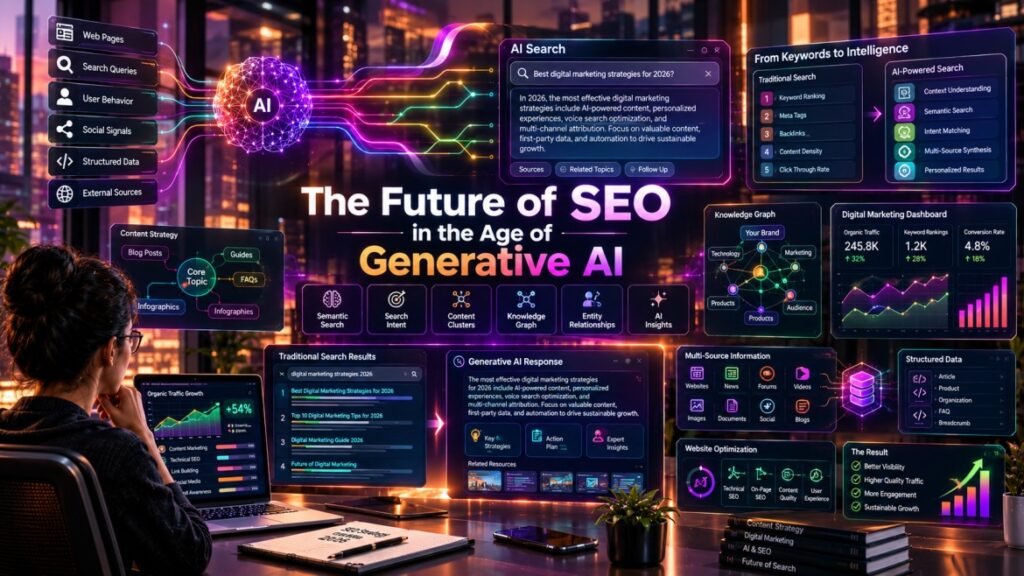
Future of SEO Search engines have always evolved alongside technology. From keyword-based indexing to semantic search, mobile-first indexing, voice search, and AI-powered results, every major shift has changed how businesses attract organic traffic.
Generative AI is now creating another major transformation.
People can increasingly ask AI systems complex questions and receive synthesized answers instead of browsing through multiple traditional search results. At the same time, search engines are incorporating generative AI directly into their experiences.
This raises an important question for marketers, publishers, businesses, and content creators:
What happens to SEO when users can get answers without visiting a website?
The answer is not that SEO disappears. Instead, the discipline is expanding.
The Future of SEO will increasingly involve helping content become discoverable, understandable, trustworthy, useful, and eligible to be referenced across both traditional search engines and AI-powered discovery systems.
Table of Contents
What Is Generative AI and Why Does It Matter for SEO?
Future of SEO Generative AI refers to artificial intelligence systems capable of producing new content such as:
- Text
- Images
- Audio
- Video
- Code
- Summaries
- Structured information
Large language models can understand questions, identify relevant information, and generate conversational responses.
For search users, this can significantly change the discovery process.
Traditional Search Journey
User Query
     ↓
Search Engine
     ↓
Search Results
     ↓
Website
     ↓
Information
AI-Assisted Search Journey
User Query
     ↓
AI Understanding
     ↓
Multiple Information Sources
     ↓
Generated Answer
     ↓
Citations / Links / Follow-up Questions
The second model can reduce the number of clicks required to find basic information.
That creates both challenges and opportunities for website owners.
Why Generative AI Is Changing Traditional SEO
Future of SEO Traditional SEO has often focused on improving rankings for specific search queries.
Important activities included:
- Keyword research
- On-page optimization
- Link building
- Technical SEO
- Content creation
- Metadata optimization
- Search intent analysis
These practices remain relevant, but the environment is becoming more complex.
AI-powered search can evaluate information based on:
- Context
- Semantic relationships
- Topical authority
- Content quality
- Entity relationships
- User intent
- Trust signals
- Source credibility
This means simply repeating a keyword throughout an article is unlikely to be a sustainable strategy.
The Evolution of Search
SEO has already experienced several major transformations.
Era 1: Keyword Matching
Early search systems relied heavily on matching words in queries with words appearing on webpages.
Era 2: Link-Based Relevance
Links became important signals for determining authority and relevance.
Era 3: Semantic Search
Search engines became better at understanding concepts rather than simply matching individual words.
Era 4: Search Intent
Modern SEO increasingly focuses on understanding what the user is actually trying to accomplish.
For example:
Query: “Best laptop for video editing”
The search intent could involve:
- Performance comparison
- Price
- Display quality
- GPU requirements
- Battery life
- Professional workloads
Era 5: Generative Search
Generative AI adds another layer by potentially synthesizing information from multiple sources into a conversational response.
This represents another significant stage in the evolution of search.
The Future of SEO: From Rankings to Visibility
Future of SEO One of the biggest conceptual changes is that SEO may no longer be measured only by traditional rankings.
A website could potentially receive visibility through:
- Traditional organic results
- Featured snippets
- AI-generated search responses
- Citations
- Entity references
- News results
- Video results
- Image results
- Local search
- Voice interfaces
This means marketers need to think about search visibility across multiple discovery surfaces.
A page that ranks highly but is rarely referenced in AI-generated answers may have a different visibility profile from a page that is frequently used as a supporting source.
AI Overviews and Zero-Click Search
Future of SEO Generative search experiences can provide users with direct answers.
This creates the possibility of more zero-click searches, where the user obtains enough information without visiting a website.
For publishers, this creates a difficult business question:
How do you earn value when users need fewer clicks?
The answer may involve developing content that provides information users cannot easily obtain from a generic summary.
Examples include:
- Original research
- Expert analysis
- First-hand experience
- Proprietary datasets
- Detailed tutorials
- Interactive tools
- Calculators
- Case studies
- Industry-specific insights
Generic information can increasingly become commoditized.
Unique information becomes more valuable.
Why Originality Will Become More Important
Future of SEO Generative AI makes it easier to create large quantities of content.
That creates a major problem.
If thousands of websites publish nearly identical AI-generated articles, the overall information environment becomes saturated.
Search engines and users therefore have stronger reasons to value content with genuine differentiation.
High-value content can include:
- Original research
- Expert interviews
- Practical experiments
- Case studies
- Proprietary statistics
- Real-world examples
- Detailed product testing
- First-hand observations
- Unique frameworks
- Industry-specific expertise
The competitive advantage may shift from producing more content to producing information that is difficult to replicate.
E-E-A-T and the Growing Importance of Trust
Experience, Expertise, Authoritativeness, and Trustworthiness are increasingly important concepts in content quality.
Generative AI can produce fluent text without necessarily possessing genuine expertise or first-hand experience.
That creates an important distinction:
Fluent content is not automatically trustworthy content.
Websites should demonstrate credibility through:
- Author information
- Expert contributors
- References
- Transparent methodology
- Updated information
- First-hand experience
- Accurate claims
- Editorial standards
For sensitive subjects such as finance, healthcare, law, and security, credibility becomes particularly important.
AI-Generated Content: Opportunity or Risk?
Generative AI can dramatically increase content-production efficiency.
A marketer can use AI to help with:
- Topic research
- Content outlines
- Keyword clustering
- Drafting
- Content summaries
- FAQ generation
- Metadata
- Content updates
- Internal linking ideas
However, publishing AI-generated material without meaningful human review can introduce:
- Factual errors
- Outdated information
- Hallucinations
- Repetitive writing
- Generic explanations
- Incorrect citations
- Weak differentiation
AI should therefore be treated as a productivity technology rather than a substitute for editorial responsibility.
How Keyword Research Is Changing
Traditional keyword research often focused on individual search phrases.
Generative search encourages a broader approach.
Instead of targeting only:
“SEO tools”
a website could build a topic ecosystem covering:
- SEO tools for beginners
- Technical SEO tools
- Keyword research tools
- SEO reporting platforms
- Enterprise SEO tools
- SEO automation
- AI SEO tools
- SEO tool comparisons
- SEO tool implementation guides
This creates topical depth.
The objective is to demonstrate comprehensive knowledge around a subject rather than repeatedly optimizing isolated pages.
Search Intent Will Become More Important
Consider the query:
“How to improve website speed”
The user may want:
- A beginner explanation
- Technical optimization instructions
- Recommended tools
- Performance testing
- Core Web Vitals information
- Developer implementation guidance
A successful SEO strategy should understand these possible intents.
AI-powered search systems can interpret context more deeply, making intent-focused content increasingly important.
The Rise of Conversational Search
Users are becoming more comfortable asking detailed questions.
Instead of:
“SEO tools”
they may ask:
“Which SEO tools should a small e-commerce business use to identify technical problems and improve organic visibility?”
This changes content strategy.
Websites should increasingly address:
- Complete questions
- Follow-up questions
- Comparisons
- Use cases
- Problems
- Scenarios
- Decision criteria
FAQ sections can help, but content should remain genuinely useful rather than being created solely for search-engine manipulation.
The Role of Structured Data
Structured data helps machines interpret information on webpages.
Depending on the content type, structured data can communicate information about:
- Articles
- Products
- Organizations
- Events
- Reviews
- Courses
- FAQs
- Local businesses
As search becomes more machine-readable, clearly structured information can help search systems understand the context of a page.
However, structured data should accurately represent the visible content and should not be treated as a shortcut to rankings.
Technical SEO in the AI Era
Technical SEO remains essential.
Websites should pay attention to:
Crawlability
Search engines need to access important content efficiently.
Indexability
Important pages should be appropriately available for indexing.
Site Architecture
Logical navigation helps both users and machines understand relationships between pages.
Page Experience
Fast, usable, mobile-friendly websites remain important.
Content Accessibility
Important information should be available in formats that search engines and users can process effectively.
Internal Linking
Contextual internal links help establish relationships between related topics.
Brand Authority May Become a Stronger SEO Asset
As AI systems synthesize information from multiple sources, recognizable and trusted entities can become increasingly important.
A strong digital presence can include:
- Consistent brand information
- Expert authors
- Industry mentions
- High-quality backlinks
- Reviews
- Social presence
- Original publications
- Professional profiles
- Community participation
This creates an important shift from simply optimizing webpages to building a recognizable digital entity.
The Impact of Digital Transformation on SEO
Digital transformation has moved businesses from traditional marketing channels toward interconnected digital ecosystems.
Companies now interact with customers through:
- Websites
- Mobile applications
- Social media
- Search engines
- AI assistants
- Online marketplaces
- Messaging platforms
- Video platforms
SEO therefore increasingly overlaps with broader digital visibility.
The goal is no longer simply:
“Rank this webpage.”
It becomes:
“Make this organization discoverable wherever customers search for information.”
This broader perspective will influence the Future of SEO as AI becomes integrated into more digital experiences.
Challenges Created by Generative AI
1. Content Saturation
AI can produce enormous quantities of content.
The internet may therefore become increasingly crowded with similar articles.
2. Declining Organic Clicks
If AI-generated search answers satisfy user questions directly, some informational searches may generate fewer website visits.
3. Attribution
Users may consume information without clearly understanding which sources contributed to an AI-generated answer.
4. Hallucinations
AI systems can produce convincing but inaccurate information.
5. Rapid Algorithm Changes
Search and AI systems are evolving quickly, making long-term optimization strategies more difficult.
6. Measuring AI Visibility
Traditional ranking tools may not fully capture visibility within conversational AI systems.
Opportunities for SEO Professionals
The changing search environment also creates new career and business opportunities.
SEO professionals can expand into:
- AI search optimization
- Content strategy
- Entity optimization
- Technical SEO
- Digital PR
- Content intelligence
- AI-assisted content operations
- Search analytics
- Conversion optimization
- Brand visibility strategy
The modern SEO professional increasingly needs a combination of:
- Search knowledge
- Content expertise
- Data analysis
- Technical understanding
- AI literacy
- User-experience awareness
Future Trends in SEO
1. AI Search Visibility
SEO strategies will increasingly consider whether content is discoverable and referenced in AI-powered search environments.
2. Search Everywhere Optimization
Users may discover brands through search engines, AI assistants, social platforms, video platforms, marketplaces, and specialized applications.
3. First-Hand Experience
Original experiences, research, testing, and expert commentary can become increasingly valuable.
4. AI-Assisted SEO Workflows
AI can automate repetitive activities such as:
- Keyword clustering
- Content briefs
- Metadata suggestions
- Internal-link discovery
- Content gap analysis
- Technical issue classification
5. Human + AI Content Teams
The most effective workflow may combine AI’s speed with human expertise, verification, creativity, and editorial judgment.
6. Entity-Based Optimization
Search systems increasingly need to understand relationships between people, organizations, products, concepts, locations, and events.
Building a consistent digital entity may therefore become an important component of long-term search visibility.
How Businesses Can Prepare for the Future
Businesses can begin preparing with a practical framework.
Step 1: Audit Existing Content
Identify:
- Outdated articles
- Thin pages
- Duplicate topics
- Poor-quality content
- Pages without clear search intent
Step 2: Build Topic Clusters
Create comprehensive content ecosystems around important business topics.
Step 3: Add Original Insights
Include:
- Data
- Examples
- Experiments
- Case studies
- Expert opinions
- Proprietary information
Step 4: Improve Technical Foundations
Focus on:
- Crawlability
- Indexation
- Site architecture
- Performance
- Mobile usability
- Internal linking
Step 5: Use AI Responsibly
Use AI to accelerate research and production while maintaining human review and factual verification.
Step 6: Measure More Than Rankings
Monitor:
- Organic traffic
- Impressions
- Click-through rate
- Conversions
- Branded searches
- Referral traffic
- Content engagement
- Search visibility
A New SEO Content Framework
A modern content strategy can follow this model:
Search Intent → Topic Depth → Original Value → Trust → Technical Accessibility → Distribution → Measurement
This approach is more sustainable than producing large quantities of keyword-focused articles.
For example, instead of publishing ten generic articles about “AI tools,” a technology website could create:
- An original AI tool comparison
- Real-world testing results
- Detailed implementation tutorials
- Cost analysis
- Use-case guides
- Expert interviews
- Industry-specific recommendations
- Regular updates
The result is a stronger information resource rather than a collection of isolated SEO pages.
Will Generative AI Replace SEO?
Generative AI is changing search, but that does not mean optimization becomes irrelevant.
As long as people use digital systems to discover information, businesses will need to improve how their information is understood and surfaced.
The optimization target may simply change.
Instead of optimizing only for:
Search Engine → Ranking → Click
the ecosystem may increasingly involve:
User → Search/AI Interface → Understanding → Source Selection → Answer → Brand Interaction
SEO professionals will therefore need to think beyond traditional rankings.
The Future of SEO: What Should Marketers Focus On?
The most resilient strategies are likely to focus on fundamentals that remain valuable regardless of interface changes:
- Help users solve real problems
- Publish original information
- Demonstrate expertise
- Maintain accurate content
- Build recognizable brands
- Improve technical accessibility
- Understand search intent
- Use structured information appropriately
- Measure business outcomes
- Adapt to new search interfaces
Generative AI changes the mechanism of information discovery, but usefulness and trust remain central.
Conclusion
The Future of SEO is moving beyond traditional keyword optimization toward a broader discipline centered on information quality, user intent, authority, entities, technical accessibility, and visibility across AI-powered discovery systems.
Generative AI will make content production faster, but speed alone will not guarantee visibility.
As generic content becomes easier to create, unique knowledge, first-hand experience, original research, credible expertise, and strong brands can become increasingly valuable.
Digital transformation will continue connecting search with websites, applications, social platforms, marketplaces, and AI assistants. SEO professionals who understand this wider ecosystem can adapt their strategies accordingly.
The next generation of SEO will not simply be about getting a webpage to rank.
It will be about making valuable information discoverable, understandable, trustworthy, and useful wherever people—or AI systems—look for answers.