
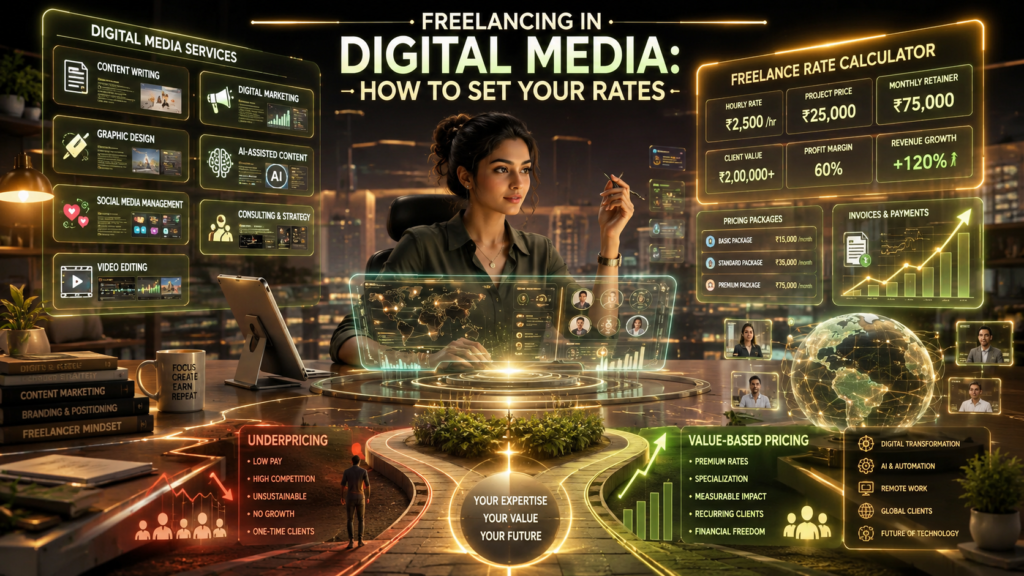
Introduction
Digital media has transformed the way businesses create, distribute, and monetize content. From social media management and video production to graphic design, copywriting, podcasting, and digital marketing, companies increasingly rely on independent professionals to handle specialized work.
This growing demand has created exciting opportunities for freelancers. However, one question continues to challenge both beginners and experienced professionals: How much should I charge?
Setting freelance rates is not simply about choosing an hourly number. Your pricing should reflect your skills, experience, project complexity, business costs, turnaround time, and the value you deliver to a client.
Understanding Freelancing in Digital Media: How to Set Your Rates can help professionals avoid underpricing, communicate their value confidently, and build a sustainable freelance career.
Table of Contents
Why Setting the Right Freelance Rate Matters
Freelancing in Digital Media Many new freelancers make the mistake of charging as little as possible to attract clients. While competitive pricing can help build an initial portfolio, consistently working for very low rates can create financial and professional problems.
Your rate should account for:
- Professional skills and experience
- Time required to complete a project
- Software and subscription costs
- Taxes and business expenses
- Client communication and revisions
- Research and project management
- Portfolio and industry expertise
- Urgency and delivery deadlines
- Business value created for the client
A well-calculated rate allows you to spend less time chasing projects and more time delivering high-quality work.
Understanding Different Freelance Pricing Models
There is no universal pricing model for digital media freelancers. The best approach depends on the service and client.
Hourly Rates
Hourly pricing is straightforward and works well when project requirements are uncertain.
For example, a freelance social media manager might charge ₹1,000 per hour for strategy development, content planning, or consultation.
However, hourly pricing has a limitation: your income becomes closely connected to the number of hours you work.
Project-Based Pricing
Project-based pricing is often more attractive for specialized digital media services.
For example:
- Logo design: ₹5,000–₹20,000
- Short-form video editing: ₹2,000–₹10,000 per video
- Blog writing: ₹1,500–₹8,000 per article
- Social media management: ₹15,000–₹60,000+ per month
- Website content strategy: ₹20,000–₹75,000+
These are illustrative ranges, not fixed market rates. Actual pricing depends heavily on experience, niche, geography, scope, and client expectations.
Retainer Pricing
A retainer involves a recurring monthly agreement.
For example, a freelancer managing a company’s social media channels could charge a monthly fee covering:
- Content calendars
- Social media posts
- Short-form videos
- Community management
- Analytics reports
- Strategy meetings
Retainers provide greater income predictability and can create stronger long-term client relationships.
Calculate Your Minimum Sustainable Rate
Freelancing in Digital Media Before deciding what clients should pay, calculate what you need to earn.
Suppose your target annual freelance income is ₹9,00,000. You also expect ₹1,80,000 in annual business expenses.
Your required revenue becomes:
₹9,00,000 + ₹1,80,000 = ₹10,80,000
If you realistically expect to work 1,200 billable hours per year:
₹10,80,000 ÷ 1,200 = ₹900 per billable hour
This does not automatically mean you should quote exactly ₹900 per hour. Your final rate may need to be higher because not every working hour is billable.
Time spent finding clients, attending meetings, marketing your services, preparing proposals, learning new tools, and handling administration must also be considered.
Price According to Value, Not Just Time
Freelancing in Digital Media One of the most important principles in freelancing is understanding the difference between cost-based pricing and value-based pricing.
Imagine a freelancer spends five hours creating a social media campaign that helps a business generate ₹2 lakh in additional revenue.
Charging only according to five hours may undervalue the result.
Value-based pricing considers the business impact of the work, including:
- Revenue generation
- Lead generation
- Brand visibility
- Customer engagement
- Time saved
- Operational efficiency
- Improved customer experience
The stronger the measurable business outcome, the stronger the case for premium pricing.
Research Your Market
Freelancing in Digital Media Freelancers should understand what similar professionals charge, but competitors should not become the only source of pricing decisions.
Research:
- Freelance marketplaces
- Professional communities
- Industry salary reports
- Agency pricing
- Job descriptions
- Specialist consultants
- Your target client’s budget level
Also compare yourself with freelancers offering similar expertise rather than simply comparing job titles.
A specialist with five years of experience and a strong portfolio should not necessarily charge the same as a beginner offering the same service.
Create Different Pricing Packages
Freelancing in Digital Media Packages make pricing easier for clients to understand.
For example, a social media freelancer could offer:
Basic Package
- 8 social posts
- Monthly content calendar
- Basic performance report
Professional Package
- 15 social posts
- 8 short videos
- Content strategy
- Community management
- Detailed analytics
Premium Package
- 20+ social posts
- Short-form video production
- Paid campaign support
- Strategy consultation
- Advanced analytics
- Competitor research
This approach allows clients to select a service level based on their needs and budget.
Charge Extra for Scope Changes
Freelancing in Digital Media Scope creep is one of the biggest profitability problems for freelancers.
A client may initially request a five-minute video but later ask for additional versions, subtitles, animations, thumbnails, and multiple revisions.
Your agreement should clearly define:
- Deliverables
- Number of revisions
- Deadlines
- Payment schedule
- Additional services
- Rush charges
- Cancellation terms
Anything outside the agreed scope should be treated as additional work.
The Impact of Digital Transformation on Freelance Pricing
Digital transformation has significantly expanded the freelance economy. Businesses can now work with specialists from almost anywhere, while freelancers can serve international clients without relocating.
Cloud collaboration, artificial intelligence, automation, remote communication platforms, and digital payment systems have reduced many traditional barriers.
At the same time, competition has increased.
A freelancer may now compete with professionals from dozens of countries. This makes specialization increasingly important.
Instead of positioning yourself as simply a “content writer” or “video editor,” consider developing a specific niche such as:
- Healthcare content
- Insurance marketing
- B2B technology content
- Financial video production
- E-commerce social media
- AI-assisted content strategy
Specialization can make your expertise easier to differentiate and justify premium rates.
How AI Is Changing Freelance Pricing
Freelancing in Digital Media Artificial intelligence is changing how digital media work is produced.
AI tools can accelerate research, generate initial concepts, automate repetitive tasks, assist with editing, and support content personalization.
However, AI does not eliminate the need for professional judgment.
Clients still need people who can:
- Understand business objectives
- Develop creative strategies
- Verify information
- Maintain brand consistency
- Make editorial decisions
- Analyze performance
- Communicate with stakeholders
The future of technology will likely reward freelancers who combine AI proficiency with human creativity, critical thinking, domain knowledge, and communication skills.
Instead of charging less because AI makes you faster, consider how that increased efficiency can allow you to deliver better outcomes.
Challenges Freelancers Face When Setting Rates
Fear of Losing Clients
Freelancing in Digital Media Many freelancers hesitate to increase their prices because they believe clients will leave.
Some clients may leave. However, consistently underpricing your services can be more damaging in the long term.
Inconsistent Income
Freelance income can fluctuate significantly. Building multiple recurring clients can reduce this risk.
Global Competition
Remote work has created a global marketplace. Differentiation through specialization, quality, reliability, and communication is essential.
Constant Skill Development
Digital media evolves rapidly. Freelancers need to continuously learn new platforms, formats, analytics tools, and AI capabilities.
Opportunities for Digital Media Freelancers
The market continues to create opportunities in areas such as:
- AI-assisted content creation
- Short-form video
- Podcast production
- Influencer marketing
- Social commerce
- Personal branding
- Digital advertising
- SEO content
- Newsletter management
- Marketing automation
- Data-driven content strategy
Freelancers who combine creative skills with business and technology expertise can position themselves as strategic partners rather than temporary contractors.
Future Trends in Freelance Digital Media
The next phase of freelancing is likely to be shaped by AI, automation, creator platforms, remote collaboration, and increasingly specialized expertise.
Some important trends include:
- AI-augmented freelancing – Professionals will use AI to accelerate research, production, analysis, and workflow automation.
- Outcome-based pricing – Clients will increasingly focus on measurable business results rather than hours worked.
- Specialized micro-agencies – Experienced freelancers may build small teams around highly specific services.
- Global client acquisition – Digital platforms will make international business development more accessible.
- Subscription services – Monthly content, design, and marketing packages will become increasingly common.
- Personal brands – Freelancers with strong online authority may attract clients without relying entirely on marketplaces.
A Practical Formula for Setting Your Rate
A simple framework can help you create a sustainable starting point:
Minimum Rate = (Desired Income + Business Expenses + Tax Buffer) ÷ Realistic Billable Hours
Then adjust your final price based on:
- Expertise
- Complexity
- Client size
- Business impact
- Urgency
- Market demand
- Project risk
Review your rates periodically instead of treating your initial pricing as permanent.
Final Thoughts
Pricing is one of the most important business skills a freelancer can develop. Your rate should not be based solely on what competitors charge or what you think a client can afford.
The goal is to create pricing that is profitable for you while providing clear value to the client.
Freelancing in Digital Media: How to Set Your Rates ultimately comes down to understanding your economics, communicating your value, specializing strategically, and continuously improving your skills.
As digital transformation accelerates and the future of technology creates new forms of digital work, freelancers who combine expertise, creativity, AI literacy, and business thinking will be better positioned to command sustainable rates and build long-term careers.