
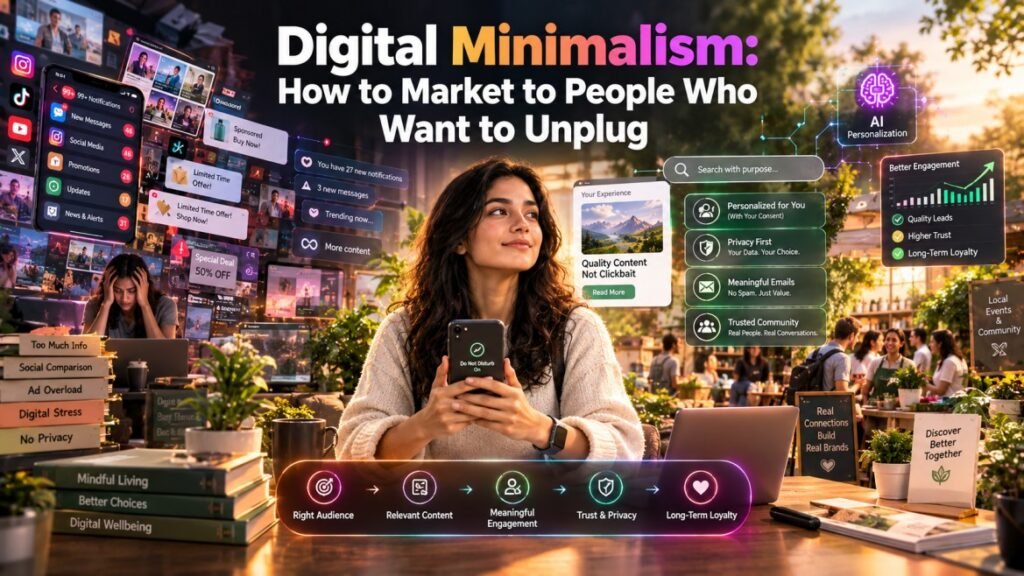
Introduction
Digital technology has transformed the way people discover products, communicate with brands, consume content, and make purchasing decisions. Businesses have more channels than ever before: social media, search engines, email, mobile applications, influencers, video platforms, notifications, and personalized advertising.
But there is an interesting contradiction at the heart of modern digital transformation.
While companies are trying to become more digitally connected, a growing group of consumers is actively trying to become less digitally distracted.
They may turn off notifications, delete unnecessary applications, reduce social media usage, avoid excessive advertising, or deliberately spend more time away from screens.
This behavior creates a new marketing challenge:
How can brands reach people who do not want to be constantly reached?
The answer is not simply to create more advertisements.
It requires marketers to understand Digital Minimalism and rethink the relationship between attention, technology, content, privacy, and consumer trust.
For businesses, this shift creates both challenges and opportunities. The future of marketing may not belong exclusively to brands that capture the most attention. It may increasingly favor brands that know when not to demand attention.
Table of Contents
What Is Digital Minimalism?
Digital Minimalism is an approach to technology use that emphasizes intentionality rather than constant connectivity.
Instead of using every available digital platform simply because it exists, people evaluate whether a particular technology actually provides meaningful value.
The underlying principle is simple:
Use technology deliberately, rather than allowing technology to automatically determine how you spend your attention.
A person following a minimalist digital lifestyle might:
- Disable unnecessary notifications
- Reduce social media usage
- Unsubscribe from unwanted emails
- Avoid excessive online shopping
- Spend designated periods offline
- Prefer meaningful communication over constant messaging
- Choose fewer digital platforms
- Replace endless scrolling with intentional activities
For marketers, this creates an important distinction between attention and valuable engagement.
Why Are Consumers Trying to Unplug?
Several factors are contributing to growing interest in reduced digital consumption.
1. Information Overload
Consumers are exposed to enormous amounts of information every day.
They may encounter:
- Social media posts
- Advertisements
- Promotional emails
- Push notifications
- News alerts
- Short-form videos
- Influencer content
- Product recommendations
When every brand competes for attention, consumers can become selective about what deserves their time.
2. Notification Fatigue
Notifications were originally designed to provide useful information.
However, people can receive dozens or even hundreds of notifications across different devices and applications.
Over time, consumers may respond by:
- Turning notifications off
- Muting applications
- Uninstalling apps
- Reducing social media usage
- Ignoring promotional messages
For marketers, this means notification frequency cannot substitute for relevance.
3. Privacy Awareness
Consumers are becoming increasingly aware that digital platforms can collect and analyze behavioral information.
Concerns may include:
- Tracking
- Cookies
- Personalization
- Location information
- Purchase history
- Online behavior
- Data sharing
A consumer who values digital simplicity may also value brands that minimize unnecessary data collection.
The Marketing Challenge
Traditional digital marketing often operates on a simple assumption:
More exposure = more opportunities to convert.
But that assumption becomes less reliable when consumers intentionally reduce their digital exposure.
A minimalist consumer may:
- Avoid social media advertisements
- Use ad blockers
- Unsubscribe from mailing lists
- Ignore push notifications
- Limit screen time
- Search directly rather than browse feeds
The solution is not to increase the volume of marketing.
The better approach is to increase the value per interaction.
How to Market Without Creating Digital Noise
1. Lead With Value
The first question marketers should ask is:
“What useful information are we giving the customer?”
Instead of creating content simply to fill a publishing calendar, brands can focus on:
- Practical guides
- Educational resources
- Product comparisons
- Original research
- Useful tools
- Clear tutorials
- Meaningful insights
A consumer who wants less digital noise is more likely to appreciate content that solves a genuine problem.
2. Choose Fewer, Better Channels
Brands do not necessarily need to maintain an aggressive presence everywhere.
A company might achieve better results by identifying where its audience actually wants to communicate.
For example:
Instead of:
- 7 social platforms
- Daily promotional emails
- Multiple push notifications
- Constant retargeting
A company could use:
- High-quality SEO content
- One relevant social channel
- A useful newsletter
- A well-designed website
The objective is not maximum digital presence.
It is meaningful presence.
3. Create Permission-Based Marketing
Permission is becoming increasingly valuable.
A customer who voluntarily subscribes to a newsletter has expressed an interest in receiving information.
Brands should respect that relationship.
Good practices include:
- Clear subscription expectations
- Reasonable email frequency
- Easy unsubscribe options
- Relevant content
- No misleading subject lines
- Transparent data practices
Permission transforms marketing from interruption into a relationship.
4. Build a Strong Website
A website becomes especially important when consumers reduce their dependence on social media.
Your website should make it easy to:
- Find information
- Compare products
- Understand pricing
- Read reviews
- Contact the company
- Make purchases
- Access support
A minimalist customer should not have to navigate ten pop-ups before finding basic information.
Simple design can itself become a competitive advantage.
The Power of Search Marketing
Search engines provide an interesting opportunity.
A person who wants to reduce social media usage may still actively search for solutions.
For example:
Search:
“Best air purifier for a small bedroom”
This represents intentional behavior.
The consumer has a specific need.
A brand can respond with:
- A detailed comparison
- Buying guidance
- Product specifications
- Independent evidence
- Helpful FAQs
This is fundamentally different from interrupting someone who is casually scrolling.
Search marketing therefore remains highly relevant to audiences seeking more intentional digital experiences.
Content Marketing for Minimalist Consumers
Content should become more useful, not simply more frequent.
Long-Form Educational Content
Detailed articles can answer complex questions in one place.
Examples include:
- Buying guides
- Tutorials
- Research reports
- Industry explainers
- Case studies
Evergreen Content
Evergreen resources reduce the need to constantly produce new promotional messages.
Examples:
- Beginner guides
- Checklists
- Glossaries
- Tutorials
- Resource libraries
Utility-Based Content
The most valuable content may actually help people make decisions.
Examples:
- Calculators
- Templates
- Comparison tools
- Product selectors
- Checklists
This approach respects the customer’s time.
Email Marketing in a Minimalist World
Email remains useful, but inbox overload is a serious problem.
Brands should consider a quality-over-quantity strategy.
Instead of sending five promotional emails every week, a company might send one carefully curated message.
A useful newsletter could contain:
- One important insight
- One useful resource
- One relevant product
- One practical recommendation
The subscriber should feel that opening the email was worth the time.
Offline Marketing Is Making a Comeback
One of the most interesting opportunities is that digital minimalism does not mean consumers stop responding to marketing.
It can shift attention toward other channels.
Brands can explore:
- Print publications
- Direct mail
- Events
- Community activities
- Retail experiences
- Packaging
- Outdoor advertising
- Local partnerships
- In-person workshops
For some audiences, physical experiences may feel more distinctive precisely because so much marketing has moved online.
Experiential Marketing
People who want to reduce screen time may still value memorable experiences.
Brands can create:
- Workshops
- Demonstrations
- Community events
- Pop-up experiences
- Product testing sessions
- Educational seminars
The experience itself becomes the marketing channel.
A customer does not need to spend twenty minutes scrolling through advertisements if they can understand the value of a product through a five-minute real-world demonstration.
Build a Brand People Seek Out
One of the strongest responses to digital minimalism is building brand recognition strong enough that consumers intentionally search for the company.
This changes the relationship:
Traditional approach:
Brand → Advertisement → Consumer
Intent-driven approach:
Need → Search → Brand
The second model depends more heavily on:
- Brand trust
- Reputation
- Product quality
- Search visibility
- Customer recommendations
- Word of mouth
Word-of-Mouth Marketing Becomes More Important
When consumers reduce their exposure to advertising, recommendations can become more valuable.
A satisfied customer can influence others through:
- Personal conversations
- Community groups
- Reviews
- Recommendations
- Professional networks
Brands should therefore focus on creating products and experiences people naturally want to recommend.
Privacy as a Marketing Advantage
Privacy should not only be treated as a compliance requirement.
It can become part of brand positioning.
Companies can communicate:
- What data they collect
- Why they collect it
- How long they retain it
- How customers can control their information
- What information is not collected
Transparency can help differentiate brands in markets where consumers are increasingly cautious about digital tracking.
Digital Minimalism and Brand Design
A minimalist audience may also respond positively to minimalist communication.
This can include:
- Clean websites
- Simple navigation
- Clear pricing
- Short forms
- Limited pop-ups
- Fewer interruptions
- Straightforward copy
- Accessible design
The principle is:
Reduce friction, reduce noise, increase clarity.
How AI Changes Minimalist Marketing
Artificial intelligence is changing digital marketing through:
- Personalization
- Content generation
- Customer segmentation
- Recommendation systems
- Predictive analytics
- Conversational interfaces
- Automated customer support
However, AI creates a paradox.
Businesses can now generate enormous amounts of content at low cost.
But consumers may value less content and more relevance.
This means the future use of AI in marketing should focus on improving relevance rather than simply increasing content volume.
AI-Powered Personalization Without Over-Personalization
Personalization can improve customer experiences, but excessive personalization can feel intrusive.
For example:
Useful personalization:
“Based on your previous purchase, here is a compatible replacement.”
Potentially uncomfortable personalization:
“We noticed you searched for this product several times last night.”
The technology may be similar, but the customer experience is very different.
Minimalist marketing should prioritize helpful personalization with clear boundaries.
Digital Transformation and Consumer Attention
The impact of digital transformation on marketing has been enormous.
Businesses now have more opportunities to reach customers than ever before.
But increased connectivity also creates increased competition for attention.
This produces an interesting market dynamic:
More technology → More channels → More content → More noise → Greater consumer selectivity
Brands that understand this cycle can adapt their strategies.
The goal is not to reverse digital transformation.
The goal is to make digital transformation more human-centered.
Challenges of Marketing to People Who Want to Unplug
1. Measuring Offline Influence
Digital marketing provides detailed metrics.
Offline interactions can be harder to measure.
A customer may attend an event, talk to a friend, and purchase several weeks later.
Attribution becomes more complicated.
2. Reduced Digital Reach
If consumers intentionally limit digital exposure, traditional performance marketing channels may reach them less frequently.
3. Balancing Frequency and Relevance
Marketers need enough visibility to remain memorable without becoming intrusive.
4. Maintaining Consistency
A minimalist strategy requires discipline.
Organizations may be tempted to return to high-volume campaigns when short-term metrics decline.
5. Data Limitations
Privacy-focused consumers may share less information, reducing the amount of behavioral data available for personalization.
Opportunities for Marketers
Digital minimalism creates several strategic opportunities.
1. Premium Attention
When customers intentionally choose where to spend attention, earning that attention can become more valuable.
2. Trust-Based Marketing
Transparent brands can differentiate themselves through:
- Privacy
- Honesty
- Useful information
- Clear communication
3. Owned Media
Brands can invest in:
- Websites
- Blogs
- Email newsletters
- Communities
- Podcasts
- Knowledge hubs
Owned channels provide more control over the customer relationship.
4. Community Marketing
Strong communities can reduce dependence on paid advertising.
Customers become participants rather than simply audiences.
5. Offline-Digital Integration
The future may not be purely digital.
Brands can connect online discovery with offline experiences through:
- Events
- Retail
- QR-enabled packaging
- Workshops
- Printed resources
- Local communities
Future Trends in Digital Minimalist Marketing
1. Less Content, More Utility
The future may favor brands that publish fewer but substantially more useful resources.
2. Intent-Based Marketing
Marketers may increasingly focus on consumers actively looking for solutions rather than maximizing passive impressions.
3. Privacy-Centered Personalization
Personalization will increasingly need to balance relevance with transparency and consumer control.
4. AI-Curated Marketing
AI may help customers filter information instead of simply generating more of it.
For example, an AI assistant could summarize product options and present only the most relevant choices.
This could significantly change traditional advertising models.
5. Growth of Offline Experiences
As digital fatigue increases for some consumers, physical events, retail experiences, and community-based marketing may become more strategically valuable.
How to Create a Digital Minimalist Marketing Strategy
A practical framework can be built around six steps.
Step 1: Identify Your Audience
Determine:
- What platforms they use
- What platforms they avoid
- What problems they want solved
- How they prefer to receive information
Step 2: Audit Your Marketing
Review every communication channel.
Ask:
Does this interaction provide value or simply demand attention?
Step 3: Reduce Low-Value Communication
Remove:
- Repetitive emails
- Unnecessary notifications
- Duplicate content
- Excessive pop-ups
- Irrelevant campaigns
Step 4: Increase Content Quality
Invest in:
- Research
- Original insights
- Useful tools
- Detailed guides
- Customer education
Step 5: Strengthen Offline Touchpoints
Identify opportunities for:
- Events
- Retail experiences
- Partnerships
- Community activities
Step 6: Measure Meaningful Outcomes
Go beyond impressions.
Measure:
- Qualified traffic
- Engagement quality
- Customer retention
- Direct searches
- Repeat purchases
- Referral traffic
- Customer satisfaction
- Brand searches
Example: A Minimalist Marketing Strategy
Imagine a sustainable clothing company.
Conventional approach
The company publishes:
- Multiple social posts every day
- Frequent promotional emails
- Retargeting advertisements
- Discount pop-ups
- Influencer promotions
Minimalist approach
The company focuses on:
- A high-quality sustainability guide
- Transparent product information
- One useful monthly newsletter
- Local community events
- Long-lasting product education
- Customer referral programs
- Search-optimized buying guides
The second approach may generate fewer individual marketing interactions but can create stronger relationships with consumers who value intentional consumption.
Is Digital Minimalism the End of Digital Marketing?
No.
Digital minimalism does not mean consumers will abandon technology.
People will continue to use:
- Search engines
- Smartphones
- Online shopping
- Streaming platforms
- Messaging
- Digital banking
- AI tools
The change is more subtle.
Consumers may become increasingly selective about which digital experiences deserve their attention.
Therefore, the future of marketing is unlikely to be “digital versus offline.”
It will be about intentional digital experiences combined with meaningful real-world interactions.
The Future of Marketing: Respect Attention
Attention is becoming one of the most valuable resources in the digital economy.
But attention cannot simply be demanded.
It must be earned.
Brands that respect consumer attention can differentiate themselves by:
- Communicating less frequently
- Providing more useful information
- Making privacy understandable
- Designing simpler experiences
- Creating memorable offline interactions
- Building strong communities
- Using AI responsibly
This represents a fundamental shift from attention capture toward attention respect.
Conclusion
Digital Minimalism presents marketers with an important challenge: how do you build meaningful customer relationships when some consumers actively want less digital noise?
The answer is not to abandon digital marketing.
Instead, brands need to become more intentional about how they use technology.
The impact of digital transformation has given businesses unprecedented access to consumers, but it has also created an environment saturated with information, notifications, advertisements, and competing messages.
As a result, consumers are increasingly capable of choosing what deserves their attention.
The future of marketing may therefore favor brands that understand a simple principle:
More communication does not necessarily create more connection.
Successful brands will combine high-quality content, privacy-conscious personalization, search visibility, community building, offline experiences, and thoughtful digital design.
Digital minimalism ultimately challenges marketers to stop asking:
“How can we reach customers more often?”
and start asking:
“How can we make every interaction valuable enough that customers choose to engage?”
That shift can create a healthier relationship between brands, technology, and consumers—and may become an important competitive advantage in the next stage of digital marketing.
Key Takeaways
- Digital minimalism is about intentional technology use rather than eliminating technology.
- Consumers who want to unplug may still engage with brands when the interaction provides clear value.
- High-quality content can outperform high-volume communication for certain audiences.
- Search, owned media, communities, and offline experiences provide alternatives to constant social advertising.
- Privacy and transparency can become important elements of brand differentiation.
- AI should be used to improve relevance rather than simply increase content volume.
- Digital transformation is creating both greater marketing opportunities and greater consumer attention fatigue.
- The future of marketing may combine intentional digital experiences with meaningful offline interactions.
- Brands that respect attention can build stronger, more trust-based relationships with customers.